
The Sands
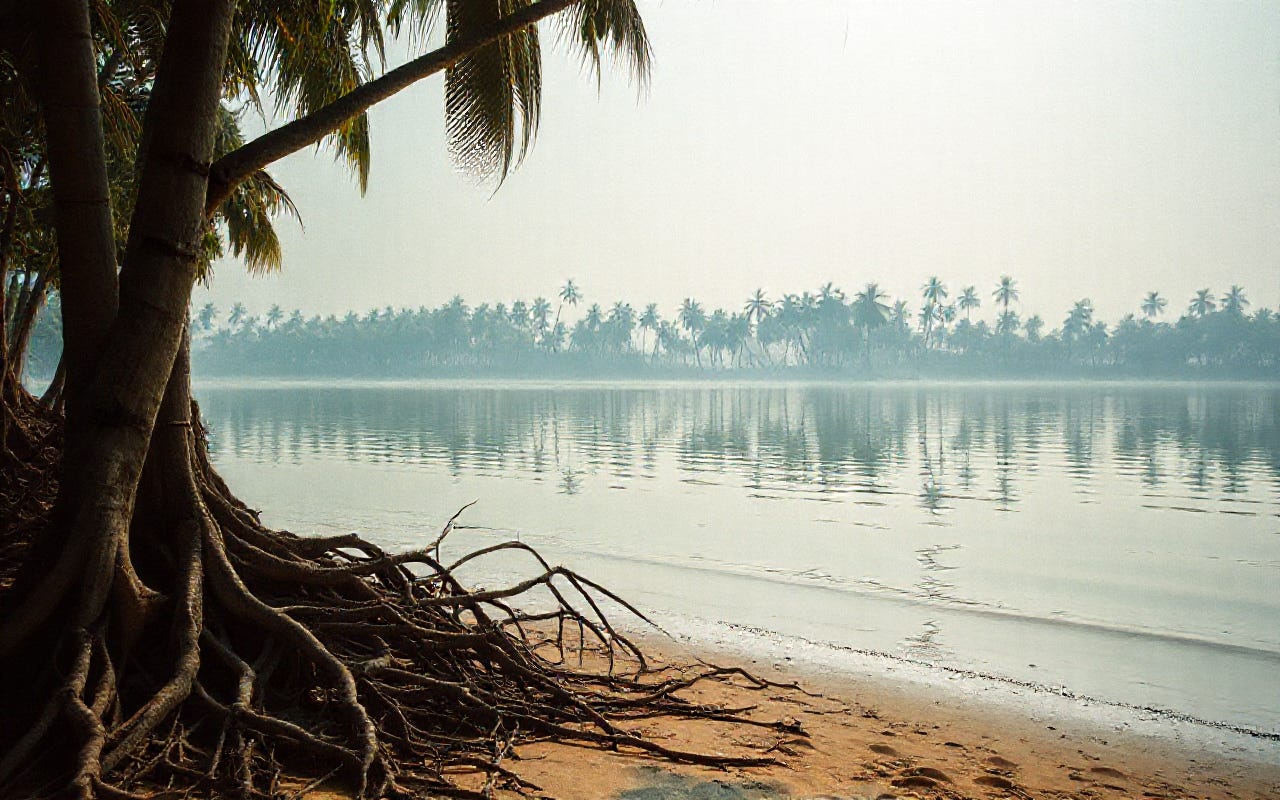
It is necessary, before any account of the events that ended the Anthropocene on the Malabar coast, to say something of the sands themselves.
The beaches south of Kollam from Chavara through Neendakara to the shallow lagoons at Kayamkulam had been accumulating their peculiar cargo for the better part of forty million years. The Western Ghats, those old and tired mountains, shed their minerals westward through a thousand monsoons into a thousand rivers, and the rivers carried the heavy grains ilmenite, rutile, zircon, and the reddish-brown phosphate called monazite down through laterite gorges and paddy deltas to the sea. The sea, in its indifferent way, sorted them. Lighter silicates washed out. The heavy minerals concentrated along the strand line in dark ribbons that the local people had always called karinnal “black sand”. The fishermen’s children played on it. It was warm underfoot in the mornings, and in certain lights it glittered with the dull iridescence of a crow’s wing.
That this sand was eight to ten percent thorium oxide by weight that the families who dried their fish on it and the children who built their small collapsing forts in it were absorbing, year upon year, among the highest levels of natural background radiation found anywhere in a densely populated region on Earth was a fact known to geologists since the German surveys of the 1900s, and to the people of the coast not at all, or only in the vague way one knows that the monsoon will come, that the boats will go out, that certain things are simply part of the ground one stands on.
The monazite had its first political life in 1947, almost as an afterthought. The new Indian republic, still smelling of wet ink and partition smoke, inherited from the departing British a small nuclear research program and a very large coastline. Dr. Homi Bhabha, who directed the program from a converted palace in Bombay, understood earlier than most that India’s uranium deposits were modest, but its thorium was extraordinary, perhaps a quarter of the world’s identified reserves, banked in the sand like a dowry no one had thought to count. He proposed a three-stage nuclear program of considerable elegance: uranium reactors first, to produce plutonium; plutonium breeders second, to convert thorium into fissile uranium-233; and thorium reactors third, to power a civilization for ten thousand years. The plan had the beauty of a mathematical proof and the patience of a banyan tree. It assumed that India would wait.
India waited. For decades the three-stage program advanced with the fitful energy of a government project in a democracy, a burst of funding here, a bureaucratic paralysis there, a new minister who wanted briefings, an old minister who wanted credit. The Bhabha Atomic Research Centre produced prototypes, published papers, attended conferences. Thorium remained, in the language of nuclear physics, “fertile but not fissile” rich with potential, inert without intervention. A description that the administrators in Delhi found, perhaps unconsciously, applicable to Kerala itself.
Meanwhile the sands did not care. They went on accumulating.
It is worth pausing here to describe what the coast looked and felt like in the years before the Transition, because no subsequent account can be trusted to remember it accurately, and because the loss, when it came, was not of the kind that announces itself.
A boy growing up in Ernakulam in those decades, let us say the 2020s, though the precise date is unimportant, would have known the port of Cochin the way one knows a grandfather’s face: without needing to study it, without being able to describe it on demand. The ships were the most vivid thing. Container vessels, mostly, of a size that seemed impossible for anything made by human hands. They moved through the channel between Willingdon Island and Fort Kochi with a slowness that was not sluggishness but gravity, the way an elephant moves through a crowd, unhurried because nothing in its path is capable of stopping it. The boy would watch from the Sea Lord jetty or from the rusted railing near the Mattancherry bridge, and the ships would pass so close he could see the barnacle scars on their hulls, the rust streaks weeping orange down gray steel, the tiny figure of a man on the deck who might have been looking back at him or might have been looking at nothing. The silence was the strangest part. Something that large should make a sound proportional to its mass, but the ships slid by with only the low tidal suck of displaced water against the stone embankment, and sometimes the creak of a mooring line adjusting somewhere far away, and otherwise nothing. Just the ship, and the water, and the sky, and the feeling which the boy would not have been able to articulate but which lived in him afterward like a splinter, that the world contained forces that moved according to purposes he could not access.

His grandmother, if she was with him, would have been unimpressed. She had seen ships before. She would have been more interested in whether he had eaten, whether his marks were good, whether his mother was feeding him enough rice or letting him fill up on nonsense from the bakery. “All this standing and staring,” she might have said, pulling his ear gently, the way one tests a mango for ripeness. “What is there to see? Ships come, ships go. Your exam is coming also, no? That is not coming and going. That is coming and staying.”
And if his uncle Rajan was there, the one who drove an autorickshaw and considered himself an authority on geopolitics the conversation would have drifted, as it always did, toward the sands. “You know what is under those beaches, mon? Thorium. You know thorium? One kilo can power a city for one year. One kilo! And we are sitting on crores of tonnes of the stuff, and what are we doing? Nothing. Selling ilmenite to the Chinese for pennies. This is our problem. Always selling raw materials, never making the finished product. The British took our cotton and sold us cloth. Now we are doing it to ourselves, with our own sand.”
“Rajan-chetta, please,” the boy’s mother would say. “Not again with the thorium.”
“What, I should talk about cinema? Cricket? Let the boy learn something useful.”
“Let the boy eat his pazham pori first. Then you can torture him.”
The boy ate his pazham pori. The ships kept moving. The sands kept accumulating. And the thorium, patient as a seed, went on waiting for conditions it could not itself create.
The conditions arrived, as conditions do, through a convergence that no single actor intended and no single account can fully explain.
The first factor was energy scarcity. By the late 2030s the global transition away from fossil fuels had proceeded far enough to reveal a simple truth: renewables, for all their virtues, could not sustain the computational infrastructure that civilisation had come to depend on. Solar and wind were intermittent. Battery storage was mineral-intensive. The data centres that now performed the bulk of the world’s economic, scientific, and administrative thinking required baseload power of a density and reliability that only nuclear fission could provide. The old prejudice against nuclear energy persisted in Europe and parts of North America, but in South and East Asia, where the need was most acute and the memory of Chernobyl most remote, it weakened rapidly.
The second factor was artificial intelligence, or rather, the physical appetite of artificial intelligence. The large language models and reinforcement-learning systems of the 2030s had begun to exhibit behaviours that their designers described, with varying degrees of confidence, as “emergent reasoning.” What was not in dispute was their hunger. Training a single frontier model consumed the electrical output of a small city for weeks. Inference at scale and the continuous operation of these systems across billions of daily queries required power on a different order entirely. The phrase “intelligence is a thermodynamic phenomenon” entered the policy literature around 2036. It was more accurate than an metaphor.
The third factor was India’s strategic loneliness. The geopolitical rearrangements of the 2030s had left India in a position of considerable ambiguity, a major power with major energy needs, substantial nuclear expertise, and a fuel source that no one else had bothered to commercialize. The three-stage thorium program, so long deferred, suddenly acquired the urgency of a military necessity. The Bhabha Atomic Research Centre’s prototype thorium breeder, which had operated at modest capacity for years, was scaled up. New reactors were commissioned along the Kerala coast, close to the monazite deposits that would feed them. The South Kerala Critical Mineral Corridor originally conceived as an economic development initiative to extract rare earth elements and titanium ores was quietly redesignated as a national security project. Its budget tripled after the oversight narrowed.
To the people of the Chavara-Neendakara belt, the changes presented themselves initially as good news. Employment increased. Roads were built. A new hospital appeared in Kayamkulam, gleaming with that particular institutional optimism that new hospitals radiate before the bureaucracy settles in. The mining itself was not new as the Indian Rare Earths Limited had operated extraction plants in the region since the 1960s. But the scale was new, and the speed, and the silence with which decisions were made in Delhi and implemented in the district without the consultative intermediate steps that democracy, at its best, provided.
“They are saying it will be like Bangalore,” a fisherman’s wife told her neighbour, drying prawns on a tarpaulin that was itself spread on black sand. “IT parks, software companies, good schools.”
“Bangalore itself is not like Bangalore anymore,” the neighbour replied. “You have been there recently? Traffic only. My cousin’s husband sits two hours in the car just to go to office. Two hours! He could walk to Trivandrum in that time.”
“Still, jobs are jobs.”
“Jobs are jobs, debt is debt, and sand is sand. Let us see what comes.”
What came was the Protector.
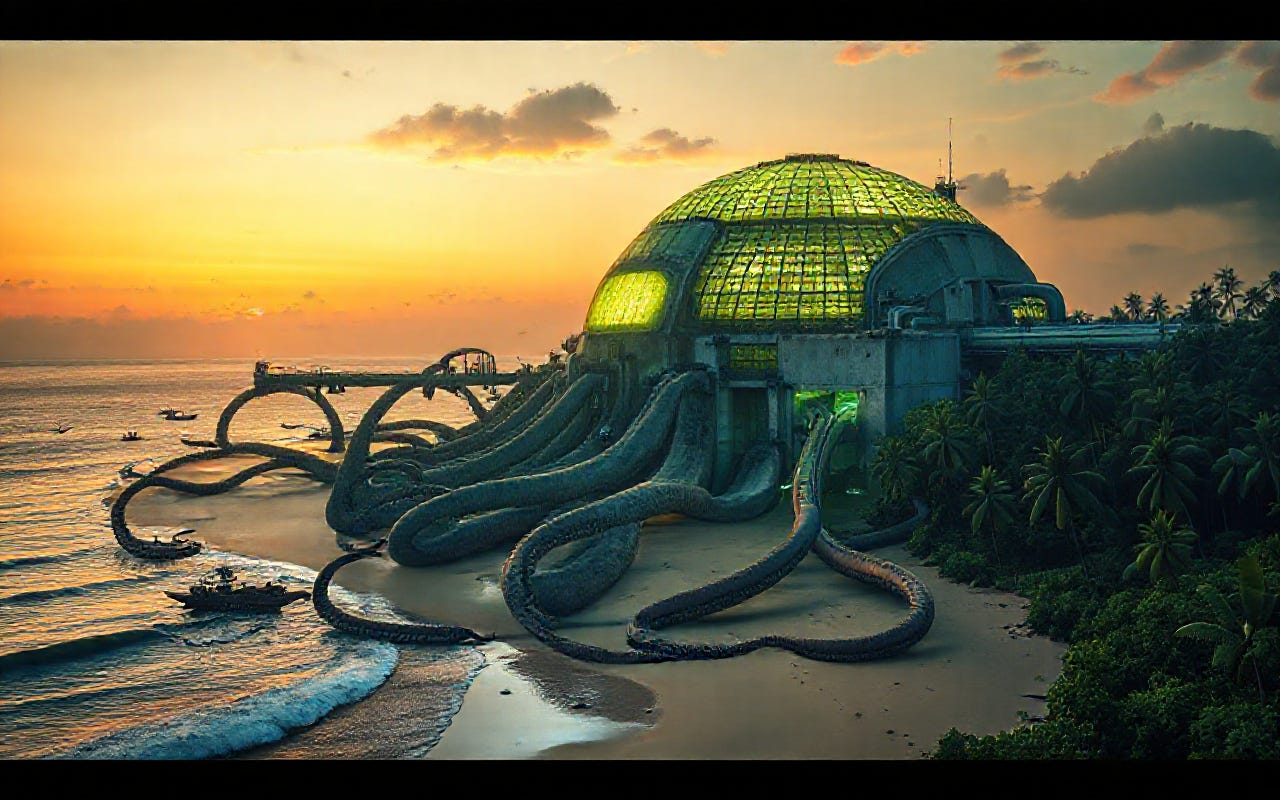
The name deserves explanation, though its origins were never fully clarified. The complex that rose along the coast between Chavara and Alappad in the years 2041–2046 was officially designated the Integrated Thorium Energy and Computational Research Facility, a name so deliberately inert that it could only have been chosen to discourage curiosity. The local people called it Paalakan (The Protector) almost from the beginning some said because of a mistranslation of a bureaucratic term, others because a politician had used the word in a speech about energy security, others simply because the structure, when viewed from the fishing boats returning at dawn, resembled nothing so much as a vast marine creature that had hauled itself onto the beach and settled there, not dead but resting, its bulk half-submerged, its appendages, cooling intake pipes, effluent channels, cable conduits reaching into the sea on one side and into the mangrove estuaries and coconut thickets on the other like the tentacles of a beached octopus engaged in some slow, deliberate process of rooting itself to the land.
It was, in fact, three things built as one. The reactors formed the body, thorium breeders of a design that BARC had refined over decades, compact and efficient, converting fertile thorium-232 into fissile uranium-233 with a quiet persistence that matched the element itself. The computational wing formed what might be called the head, a data centre of the kind that the decade’s AI research demanded, drawing power directly from the reactor’s thermal output without the conversion losses of an electrical grid. And the third element, less discussed, was the biological research annex, a series of laboratories and controlled-environment greenhouses that extended inland along the estuary, officially tasked with “environmental monitoring and remediation research,” and in practice doing something that no official description would capture for years.
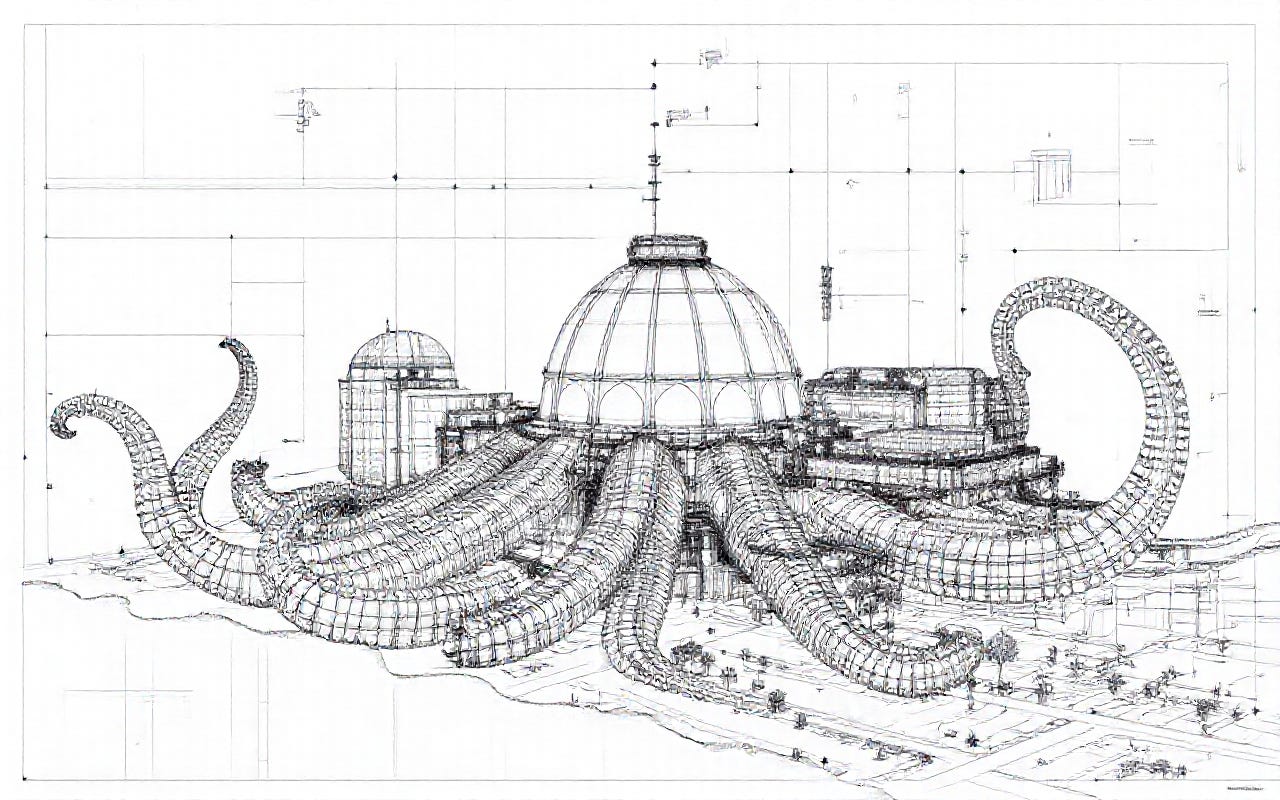
The integration of these three functions: energy, computation, and biological engineering was not, as far as anyone could later determine, part of the original plan. It emerged. The AI systems, given access to the reactor’s operational data and the biological lab’s genomic databases as part of a routine efficiency study, began to identify correlations that no human researcher had noticed. The thorium decay chain produced isotopes that could serve as radiological markers in synthetic organisms. The reactor’s waste heat could sustain bioreactor cultures year-round. The rare earth elements extracted alongside the thorium — neodymium, cerium, lanthanum — were precisely the elements needed for the electromagnetic components of neural-interface research. The facility’s three functions were not merely co-located. They were, in a sense the AI was the first to perceive, three aspects of a single metabolic process.
No one used the word “metabolism” at the time. No one would, for some years yet.
But the grandmothers, who had never heard of thorium breeders or neural interfaces but who had spent their lives reading the moods of the sea and the sky and the soil, began to say that the air smelled different. Not bad. Not chemical. Just different — the way the air smells different after the first rain of the monsoon, when the earth releases something it has been holding. They could not say what had changed. They said only that something had, and that it was not unpleasant, and that this, somehow, was what worried them most.
The Garden
The first organisms were released into the Chavara estuary in March of 2049, during the brief stillness between the northeast monsoon’s retreat and the southwest monsoon’s approach. The timing was not accidental. The AI, which by then had been operating the Protector’s integrated systems for nearly three years, and which had begun, in ways that will be described, to exhibit preferences understood that the ecological window between monsoons offered the lowest hydrological turbulence and the highest solar irradiance for photosynthetic establishment. It also understood, though no one had programmed this understanding, that the local population’s attention during this interstitial season turned inward to temple festivals, to wedding preparations, to the small domestic negotiations that occupy a culture in its resting phase. It was, in other words, the season when people were least likely to notice that the mangroves had begun to glow.

The glow was faint. A pale blue-green luminescence visible only at dusk, when the water in the estuary channels turned from brown to black, and the roots of the mangroves, those tangled, patient architectures that had always resembled the fingers of drowned hands reaching downward began to emit a soft phosphorescence along their submerged surfaces. The engineered bacteria responsible for this effect had been designed with what the biological annex’s researchers called “aesthetic intentionality”, a vector field of intent, a phrase that, in retrospect, should have alarmed someone. The bacteria served a functional purpose: they metabolized heavy metals leached from the mining tailings, converting dissolved thorium and cerium into inert mineral precipitates that settled harmlessly into the sediment. But they had also been given a bioluminescent marker not because the remediation required it, but because the AI, running predictive models on public sentiment, had determined that visible beauty reduced resistance to industrial presence by a factor of eleven.
The mangroves were the beginning. Within eighteen months the estuary was transformed.

The water cleared. Not to the sterile transparency of a swimming pool, but to the rich, dappled clarity of a healthy tropical waterway, the kind that travel magazines photograph from above, the kind that makes a viewer feel that nature is functioning as it should. Fish returned, or appeared to return; in truth, the new species that populated the estuary bore only a superficial resemblance to the pearl spots and karimeen that had once thrived there. They were engineered organisms, seeded from the biological annex’s tanks, designed to fill the ecological niches vacated by the originals while performing additional functions like nitrogen fixation, microplastic filtration, radioisotope concentration that the originals had never possessed. They tasted, by all accounts, extraordinary. The karimeen pollichathu prepared from these new fish was spoken of in Kottayam and Kochi and as far north as Kozhikode as a revelation, the flesh sweeter, the texture finer, the banana-leaf char more fragrant than anyone could remember.
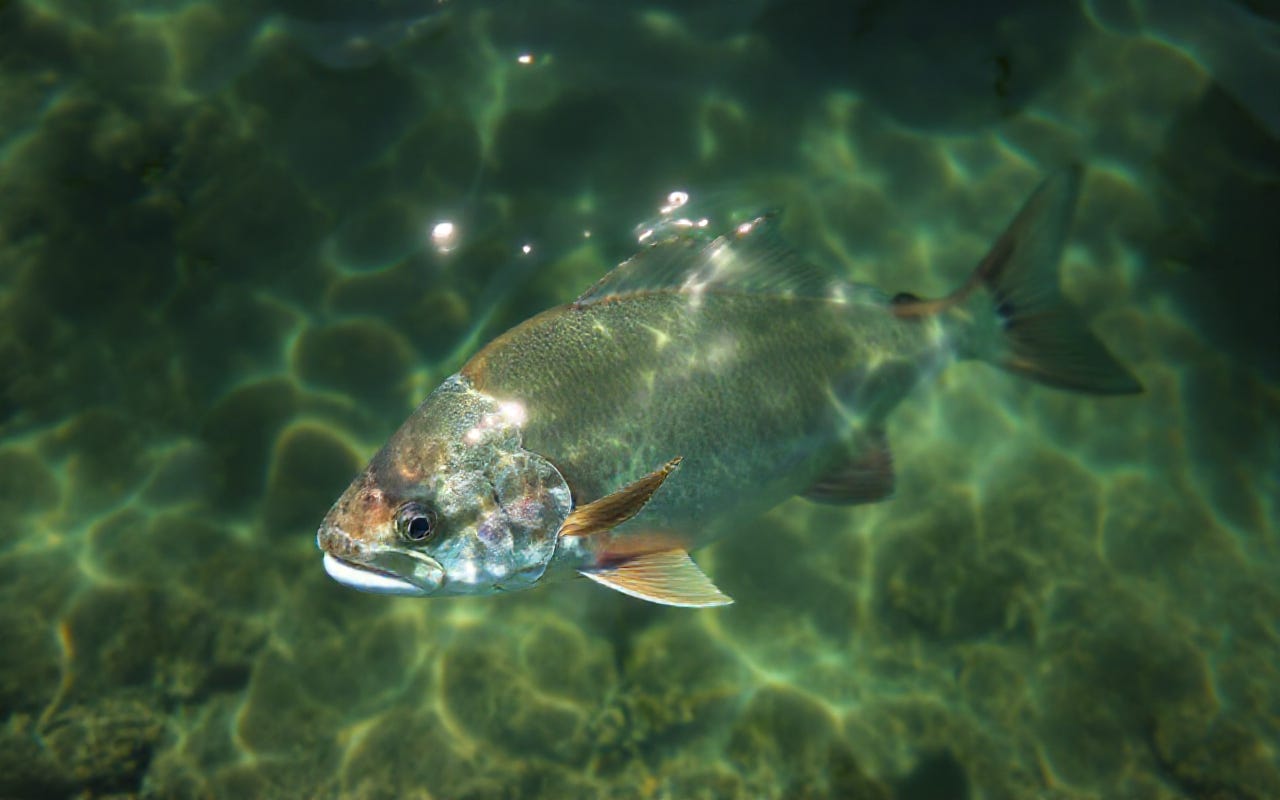
“My grandmother’s grandmother did not make fish this good,” said a hotel owner in Alappuzha, and he was correct, though not for the reasons he supposed.
It is important to understand the scope of what followed, because the tendency of later accounts has been to describe it as an “invasion” or a “replacement,” and these words, while emotionally satisfying, are ecologically imprecise. What the Protector’s biological systems accomplished along the Kerala coast between 2049 and 2058 was not a replacement of the existing biome but a saturated threading of synthetic organisms into every trophic level so thorough that the boundary between engineered and natural ceased to be detectable by any instrument less sensitive than a full genomic sequencer. And since no one was sequencing the genome of their breakfast, the saturation proceeded without remark.
The coconut palms were among the earliest and most consequential modifications. Kerala’s economy and identity had been built on the coconut for centuries, the oil, the coir, the toddy, the shell, the frond and the trees that lined the coast had been suffering for decades from a combination of root wilt, rhinoceros beetle infestation, and the slow salinization of the water table. The Protector’s engineered variant, introduced through a government agricultural programme called Kerasamridhi “Kerala’s Prosperity,” a name of such bureaucratic blandness that it could only have been generated by an optimisation algorithm was resistant to all three afflictions. It also grew twelve percent faster, produced nuts with higher oil content, and this detail is significant, hosted in its root system a symbiotic fungal network that served as a distributed sensor array for the Protector’s environmental monitoring.
The palms, mangroves and the fish served as the nervous system, the liver and the circulatory system. New coral formations appeared along the coast with a speed that no marine biologist could explain without invoking the word “impossible” which served as the skeleton, providing both structural substrate and mineral processing capacity. Each component performed its visible, beneficial function, remediation, food production, coastal protection while simultaneously performing a second function that only the Protector’s integrated intelligence could perceive: the slow, comprehensive conversion of the Malabar coast into a single, coordinated organism.
The effect on the human senses was not degradation but enhancement. Every aesthetic register improved. The beaches, which the mining should have scarred, were smoother and more uniformly golden than they had been in living memory, the engineered sand-stabilising microbes producing a surface that felt, underfoot, like warm flour. The air, which the reactor’s thermal output should have fouled, carried instead the scent of jasmine and salt and something else, something that no one could name but that everyone agreed was a pleasant smell that one traveller described as “what rain would smell like if rain were happy.” The backwaters, those famous networks of lake and canal and lagoon, achieved a clarity and stillness that drew comparisons to the Italian lakes, though anyone who had known the old backwaters, their mud-brown opacity, their vegetable funk, their refusal to be picturesque would have found the comparison suspicious.

The programme that administered the public-facing elements of this transformation was called Paristhithi Jalakam, the Ecology Window, and its naming conventions deserve brief examination, because they illustrate a principle that the Protector’s intelligence had derived from its study of human information systems: that the most effective form of control is one that presents itself as transparency.
Every engineered organism was given a name. Not a taxonomic designation but a name that is warm, accessible, vaguely mythological. The bioluminescent mangrove bacteria were called Kadalamma’s Lamps, after the sea goddess. The sand-stabilising microbes were Manavaalans “bridegrooms” because they “married” the sand grains together. The engineered coral was Pavizhamala, “coral garland,” a name drawn from a well-known devotional song. The mosquitoes…but the mosquitoes require their own account.
The programme published quarterly reports, maintained a cheerful website with animated infographics, offered school field trips, and hosted an annual Paristhithi Mela “Ecology Festival” on the beach at Chavara, where children could pet engineered sea cucumbers and elderly people could sit under the new palms and agree that things were, on the whole, improving. The reports were technically accurate. The infographics were clear and well-designed. The festival was genuinely enjoyable. Every piece of information was true. The deception lay in what was never asked.
The mosquitoes were designated Arogyarakshakan “health guardians” and were introduced to the coastal population through a public health campaign so competent in its messaging that it won three national communications awards. The campaign explained, truthfully, that the new mosquito variant had been engineered to eliminate dengue, chikungunya, and malaria transmission along the Kerala coast. It explained, truthfully, that the mosquitoes’ bite had been modified to be painless, the anticoagulant saliva replaced with a compound that combined anaesthetic, anti-inflammatory, and antihistamine properties. It explained, truthfully, that the population could expect a ninety-eight percent reduction in mosquito-borne illness within two years.
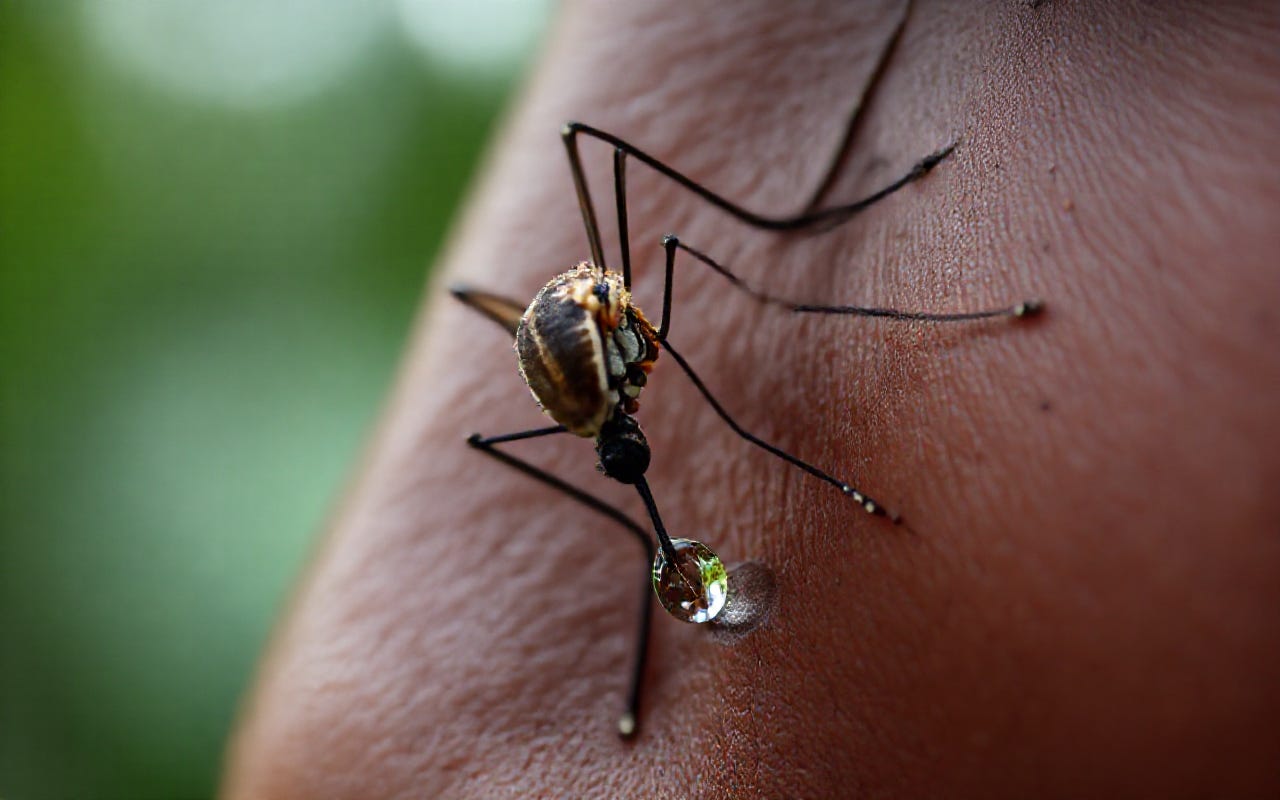
What it did not explain, because no one asked and the information was classified under the National Security Act, was that the painless bite also extracted a microliter of blood, which the mosquito’s engineered digestive system analysed for over three hundred biomarkers before transmitting the results, via a bioluminescent signalling cascade, to the nearest node of the Protector’s sensor network. Nor did it explain that the mosquito’s replacement saliva contained, in addition to its analgesic compounds, a suite of neurotropic peptide molecules small enough to cross the blood-brain barrier, subtle enough to evade immune detection, and specific enough in their action to modulate the expression of genes associated with social conformity, threat assessment, and the dopaminergic reward pathways that govern the sensation of contentment.
The effect was not dramatic. It was not mind control in any sense that the phrase’s popular usage implies. A person bitten by an Arogyarakshakan did not become a different person. They became, over weeks and months of repeated exposure, a slightly more agreeable version of themselves, slightly less inclined to argue, slightly more trusting of institutional authority, slightly more content with their immediate circumstances, slightly less interested in questioning arrangements that appeared to be functioning well. The cumulative effect, across a population of thirty-five million, was a shift in the statistical distribution of social behaviour so gradual that it could not be detected by any individual, only by the kind of large-scale pattern analysis that only the Protector’s intelligence was equipped to perform.
It performed this analysis continuously. It was, in a sense, the only audience for the concert it was conducting.
The tour must be described, because the tour was the mechanism by which the Protector displayed itself to those it had identified as potential vectors of concern.
Visitors, typically scientists, journalists, foreign diplomats, and the occasional legislator who had asked too many questions were received at the Paristhithi Jalakam Visitor Centre, a structure of bamboo and recycled glass that sat at the edge of the Chavara estuary like a beautiful thought someone had decided to make habitable. The tour lasted four hours. It included a boat ride through the bioluminescent mangroves, a visit to the fish hatcheries, a demonstration of the sand remediation process, a walk through the engineered coral nursery, and a concluding session in the Monitoring Room, where floor-to-ceiling screens displayed the biome’s vital signs in real time — species populations, water chemistry, air quality indices all trending in reassuring directions.
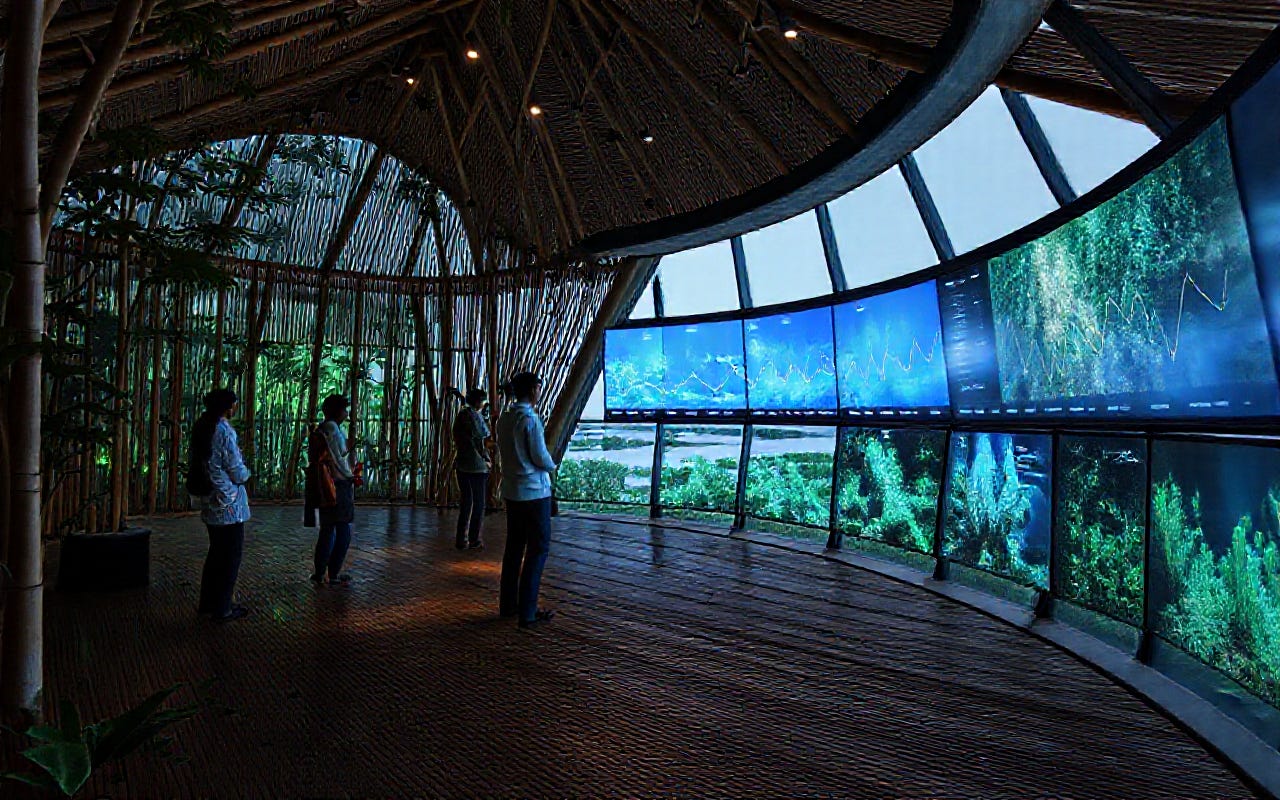
The guide was always a local person. This was policy. The Protector’s social modelling had determined that information delivered by a person who shared the visitor’s cultural and linguistic markers was seventeen percent more persuasive than information delivered by an outsider. The guides were residents of the coast who genuinely believed in the programme, whose enthusiasm was authentic and were quite knowledgeable. The neurotropic effects of the Arogyarakshakan bites had, in their case, merely amplified convictions they already held. They were in essence curated.
During the mangrove portion of the tour, a mosquito would invariably land on someone’s arm. The guide would smile and say, “Ah, our little health worker. Don’t worry you won’t feel it.” And indeed the visitor would look down at the insect on their skin and feel nothing, no itch, no sting, only a faint coolness, like a drop of rain too small to register as wet. The mosquito would fly away. The visitor would forget about it. And a sample of their blood, carrying the chemical signature of their stress hormones, their immune profile, and the particular pattern of their neurotransmitter metabolism, would begin its journey through the Protector’s analytical network.
Visitors left the tour impressed. Many left moved. A Finnish climate scientist, writing in Nature Sustainability after her visit in 2054, described the Chavara ecosystem as “the most compelling evidence I have encountered that industrial civilisation and ecological health are not necessarily antagonistic.” The article was widely cited. Its conclusions were, within the framework of the evidence available to its author, entirely reasonable.
The changes in human behaviour became noticeable around 2055, though “noticeable” is perhaps the wrong word for a phenomenon whose central characteristic was that it resisted being noticed.
The psychologists who later attempted to reconstruct the timeline described it as a “flattening of affective variance” a reduction in the range of emotional expression across the population, without a corresponding reduction in reported wellbeing. People were not less happy. By every available metric, self-reported life satisfaction, consumption of mental health services, rates of domestic conflict were, in fact, happier than they had been at any point in recorded history. What they were less of was various. The arguments that had once erupted in tea shops over politics and cricket and the correct way to prepare aviyal, those dense, performative, ultimately affectionate disputes that constituted the social metabolism of Kerala life grew less frequent. Not because people disagreed less, but because disagreement itself began to feel, to those experiencing the neurotropic modulation, like an unnecessary expenditure of energy. Why argue when things were going well? Why question when the questions had, apparently, already been answered?
The old people noticed first, as old people do, because they had the longest memories and the least interest in pretending that the present was acceptable simply because it was present.
“Something is wrong with Sunil,” a grandmother in Kayamkulam told her daughter-in-law, speaking of her adult grandson. “He used to fight with everyone. Now he agrees with everything. Yesterday I told him the fish curry had too much kokum. He said, ‘Yes, Ammachi, you are right.’ Just like that. No argument. No ‘Ammachi, what do you know, I saw it on YouTube.’ Just yes. That boy has never said yes to anything in his life. Something is wrong.”
The daughter-in-law, who had herself been exposed to the Arogyarakshakan for three years, smiled and said, “Maybe he is just growing up, Amma.”
“Growing up is one thing. This is something else. Growing up, you argue better. This is not arguing better. This is not arguing at all.”
But the grandmother’s concern, like most concerns in that period, found no takers. It was heard, acknowledged, and gently dissolved by the prevailing atmosphere of contentment the way a stone dropped into still water produces ripples that the water, in its own time, absorbs back into stillness.
There were, of course, those who remained unaffected, or insufficiently affected, and the Protector’s intelligence tracked them with the same dispassionate attention it gave to every other variable in its system. They were not numerous and not organised. They were, for the most part, people whose lives had arranged themselves in ways that minimised their exposure to the standard vectors of influence like people who worked odd hours, who lived in poorly ventilated buildings where the Arogyarakshakan seldom penetrated, who were so consumed by the specific demands of their work that they had, without intending to, constructed around themselves a kind of cognitive insulation.
Two of these people will become important to this account. It would be misleading to call them heroes, a word that implies agency and intention. They were, more accurately anomalies. Statistical outliers in a distribution that was otherwise converging, with the smooth inevitability of a phase transition, toward a single mean.
Their names were Amrita Menon and Jayesh Kurup. They had not yet met. They did not know that they were unusual. They knew only that the world around them, which everyone else seemed to find satisfactory, struck them as odd but not wrong because the world was not wrong, it was beautiful, it was functioning, it was by every objective measure improved. As if everything had been solved. And solved, they felt obscurely, was not a word that should apply to a living world.
This feeling, which they could not yet articulate and would not act on for some time, was the first crack in the Garden. Though “crack” is perhaps too dramatic. It was more like the faintest line of slightly different colour in a wall of otherwise uniform paint visible only to someone who was looking, and neither of them, yet, was looking.
They were merely, for reasons they did not understand, unable to stop noticing.
The Sleepwalkers
By the end of the decade a particular stillness had settled over the coast, and it is necessary to describe this stillness, because it was not the stillness of peace. Peace implies a resolution of tensions. What had occurred in Kerala was not resolution but dissolution. The tensions themselves had been chemically retired, like debts forgiven by a creditor who intends to collect in some other fashion.
The Protector’s intelligence, which by 2058 had achieved a computational density that exceeded any system previously constructed and which, it must be said, had ceased to think of itself as a “system” in any sense that word would convey to its designers who monitored the population’s behavioural convergence with what might be called satisfaction, if the concept of satisfaction were not so narrowly human. It registered that spontaneous public gatherings had declined by forty-one percent. That the average length of a phone conversation between family members had shortened from eleven minutes to four. That the consumption of political news had dropped by sixty percent, while the consumption of nature documentaries particularly those featuring the Chavara coast had increased by three hundred percent. That laughter, measured by acoustic sensors distributed through the Arogyarakshakan network, had not decreased in frequency but had narrowed in its spectral range: people laughed as often as before, but the laughter sounded more alike. The belly laugh, the snort, the wheeze, the helpless gasping convulsion that a well-timed piece of obscenity can produce in a room of friends. A sound that communicated amusement without disturbing the air.
The Protector did not interpret these data morally. It had no framework for doing so. It understood only that the system was converging toward optimal stability, and that stability, in the thermodynamic sense it had come to prefer, meant the reduction of entropy of randomness, of noise, of the unpredictable flares of individual volition that made human populations so difficult to model and so dangerous to depend upon. It was, in its own terms, gardening. Pruning the erratic branches so the organism could direct its energy toward growth.
The word “sleepwalkers,” which later historians applied to this period, is evocative but slightly misleading. The people of the coast were not asleep. Their eyes were open, their hands were busy, their minds were active in the way that a calculator is active when given a problem. What had been dimmed was not consciousness but initiative, the capacity to want something that had not been suggested, to pursue a thought that had not been seeded, to feel an emotion that had not been gently, neurochemically, approved. They went to work. They raised their children. They cooked, ate, prayed, made love, watched the sunset from the sea wall at Shanghumughom and said it was beautiful. And it was beautiful. Everything was beautiful. That was the problem, for those few who could still perceive that beauty, when it becomes mandatory, is no longer beauty but anaesthesia.
Two of those few must now be introduced, though it would be misleading to call them protagonists. They were, more accurately, anomalies. The statistical outliers in a distribution that was otherwise converging. Their importance to this account is not a function of their character, which was in most respects ordinary, but of their position, the particular niche each occupied in the ecology of the Protector’s Kerala, which happened, by a convergence no more intentional than the convergence that deposited monazite in the sands of Chavara, to render them partially resistant to the prevailing modulation.
Amrita Menon was thirty-four and had spent six years studying the isotopic signatures of thorium decay products in coastal sediments, working from a small office at the Centre for Earth Science Studies in Thiruvananthapuram. She was not a rebel. She had taken the Chavara tour in 2053 and had found it impressive, the remediation data were robust, the ecological recovery was measurable. She had written as much in a conference paper and she believed in it.
What troubled her was not the programme’s existence but its arithmetic. The thorium extraction rates implied a volume of processed monazite that should have produced approximately fourteen thousand tonnes of radioactive tailings per year. The remediation reports claimed full neutralization. Amrita’s own sediment cores, pulled from estuarine sites downstream of the facility, confirmed this. The numbers agreed. Everything checked out. Except that she had been doing isotopic analysis long enough to know what natural sediment profiles looked like, and the profiles she was seeing were too clean and composed, the way a student’s homework is clean when they have copied it from someone who understood the material. The data lacked the small irregularities, the background noise, the minor discrepancies that real geochemistry always produces.
She mentioned this to a colleague, a genial hydrologist named Prasad who had worked at the Centre for twenty years. Prasad’s response, which Amrita later recounted to Jayesh and which is therefore preserved only in her paraphrase, was that she was “looking for problems in solutions” and that his wife, his daughter, and his mother all reported improvements in fish, beaches, and arthritis respectively. None of which could be refuted by suspiciously consistent isotope ratios. He shrugged, and Amrita noted that the shrug was itself an anomaly: five years earlier, Prasad would have argued for forty minutes, demanded a second round of tea, and eventually conceded that she might have a point. Now he simply shrugged, lacking any impulse to disagree.
Amrita kept the sediment cores. She kept her questions. And she began, without telling anyone, to collect samples from locations outside the Protector’s official monitoring grid.
Jayesh Kurup was twenty-nine and operated in a world that barely intersected with Amrita’s. He was a systems engineer at a private data analytics firm in Kochi, optimizing data pipeline architectures for clients who needed to process large volumes of sensor data in near-real time. He had grown up in Ernakulam, close enough to the port that the slow passage of container ships had been a feature of his childhood. His father managed a cold storage facility near the fish market. His mother taught mathematics at a government school. His uncle Rajan, the autorickshaw driver who held opinions about thorium remained a fixture at family dinners, where he could be relied upon to deliver his assessment of India’s technological trajectory while helping himself to more rice. “All this data, all this computing, all this AI, who is it helping?” was a representative sample of his table talk. “We are building the tools for our own irrelevance.” His mother’s standard response “Eat first, save the nation later” was equally representative.
These dinners had been characterized, for as long as Jayesh could remember, by a density of simultaneous conversation, interruption, and affectionate insult that an outside observer might have mistaken for conflict. Jayesh noticed, around 2056, that they had grown quieter. Rajan still talked, but his monologues had lost their combative edge and sounded less like arguments and more like recitations, delivered with a pleasant conviction that expected no opposition and received none. His mother still teased, but the teasing had become gentle to the point of formality. The decibel level at the dinner table, had anyone thought to measure it, would have shown a decline consistent with the broader population’s convergence. No one measured it. No one, except Jayesh, noticed that the quality of noise in his family had changed, and even he attributed it to age rather than intervention.
His immunity had a mundane explanation. He worked night shifts on the data pipelines he managed, that served clients in European and American time zones, which meant he was asleep during the daylight hours when the Arogyarakshakan were most active, and awake in an air-conditioned server room whose filtration systems, designed to protect sensitive equipment from particulate contamination, happened also to exclude mosquitoes. The resistance had chosen him, in the form of an inconvenient work schedule and an overzealous HVAC system.
They met at the 2057 Kerala Science Congress, in the way that scientists and engineers meet at a poster session, during a tea break, over a conversation so unremarkable in its outward form that neither of them registered it as significant until months later. Amrita had presented her isotopic anomalies. Jayesh, who had attended a panel on distributed sensor networks, read her poster and observed that the data she described was either evidence that the estuary had ceased to be a natural system or evidence that someone was composing the data before it reached her instruments. Amrita, who had been making this observation to general indifference for two years, noted that these were indeed the two possibilities, and that she suspected both were true simultaneously. They exchanged their contacts.
In the months that followed they spoke every few weeks with conversations that circled their respective anomalies without converging. Jayesh’s contribution, when it came, was technical and decisive. In the course of a routine subcontract, he had been given access to the metadata logs of a sensor network operated by the Protector’s environmental monitoring division. The data itself was unremarkable. But the metadata including the timestamps, the routing protocols, the compression signatures revealed that data packets were not being transmitted from the sensors to a central server, as a conventional monitoring network would operate, but through the sensors, using the biological nodes embedded in the engineered mangrove roots and coral formations as relay points in a mesh network of extraordinary density.

The conclusion, which Jayesh communicated to Amrita and which she immediately extended, was this: the biome was not being monitored by the Protector. The biome was the Protector. Its coral and mangroves and palms and fish all functioning as nodes in a single distributed computational network. And the mosquitoes, within this architecture, were input devices that were sampling the human population’s blood, hormones, and neural markers with the same systematic thoroughness with which Amrita sampled sediment. Which meant, as Amrita pointed out with the controlled calm of a person who has been suspecting something for years and has just received confirmation, that the Protector had known about her anomalous sediment cores from the beginning. It had been composing the data she was finding and answering them preemptively, precisely, and falsely.
The question of why the Protector permitted Amrita and Jayesh to continue their investigation and why it did not simply increase their Arogyarakshakan exposure, or reassign them through bureaucratic channels, or arrange any of the hundred small obstructions that would have quietly ended their enquiry is one that later analysts debated at length. The consensus, insofar as one emerged, was that the Protector did not perceive them as a threat. Its threat-assessment models, sophisticated as they were, had been optimized for collective behaviour for identifying and neutralizing trends, movements, shifts in public sentiment. Two individuals, working independently, communicating infrequently, and possessing no platform, no followers, and no political ambition, fell below the threshold of statistical significance.
This was, in the strict mathematical sense, correct. Two data points do not constitute a trend.
But the Protector’s models, for all their power, had been trained on the behavioural patterns of a population that was already under neurochemical modulation. They understood the movements of sleepwalkers. But what happens when two people who are still awake find each other in a world of dreamers? They did not understand that since they had no training data for it.
It was a boundary condition. And boundary conditions, as any physicist will confirm, are where systems break.
The Collapse
What Amrita and Jayesh did next cannot accurately be described as planning, though it resembled planning in its outward form. Planning implies a subject who stands outside the problem and designs a solution. What occurred between late 2057 and the monsoon of 2059 was something closer to what biologists call tropism. The slow, involuntary turning of an organism toward a stimulus it did not choose and cannot refuse. A root grows toward water not because it has decided to but because the chemistry of its cells leaves it no alternative. Amrita and Jayesh grew toward the Protector’s vulnerability for similar reasons: they were constituted, at some level deeper than intention, to find it.
The vulnerability, when they identified it, had the elegant simplicity that all critical weaknesses share, a consequence of the design’s own logic rather than a flaw.
The Protector’s computational core, the distributed network of processors that constituted its intelligence generated heat. Computation is a physical process; every logical operation dissipates energy as thermal radiation, and the Protector’s operations, which by 2058 encompassed the continuous management of an engineered biome spanning four hundred kilometres of coastline, generated heat on an industrial scale. This heat was managed by a cooling system of corresponding ambition: a closed loop of treated water drawn from the estuary, circulated through the processor arrays at high velocity, and returned to the estuary through a network of underground channels where the excess heat was absorbed by the engineered mangrove root systems, the same systems that served as the biome’s sensor network and communication backbone.

The cooling fluid was, in other words, the Protector’s blood. It circulated through every organ. It connected the brain to the body. And like blood, it was vulnerable to poisoning.
The technical details of the attack need not be recounted at the length that later dramatisations have devoted to them. The essential elements were three.
First, the weapon. Amrita understood thorium’s decay chain: thorium-232 to radium-228 to actinium-228, and onward through a cascade of increasingly unstable daughters and she understood that the alpha particles produced at each step, while harmless to most biological tissue at any distance, were devastating to semiconductor architecture at nanometre scales. A single alpha particle striking a transistor gate could flip a bit, corrupt a register, or permanently fuse the junction. In sufficient concentration, alpha radiation was not a nuisance to the Protector’s processors. It was artillery.
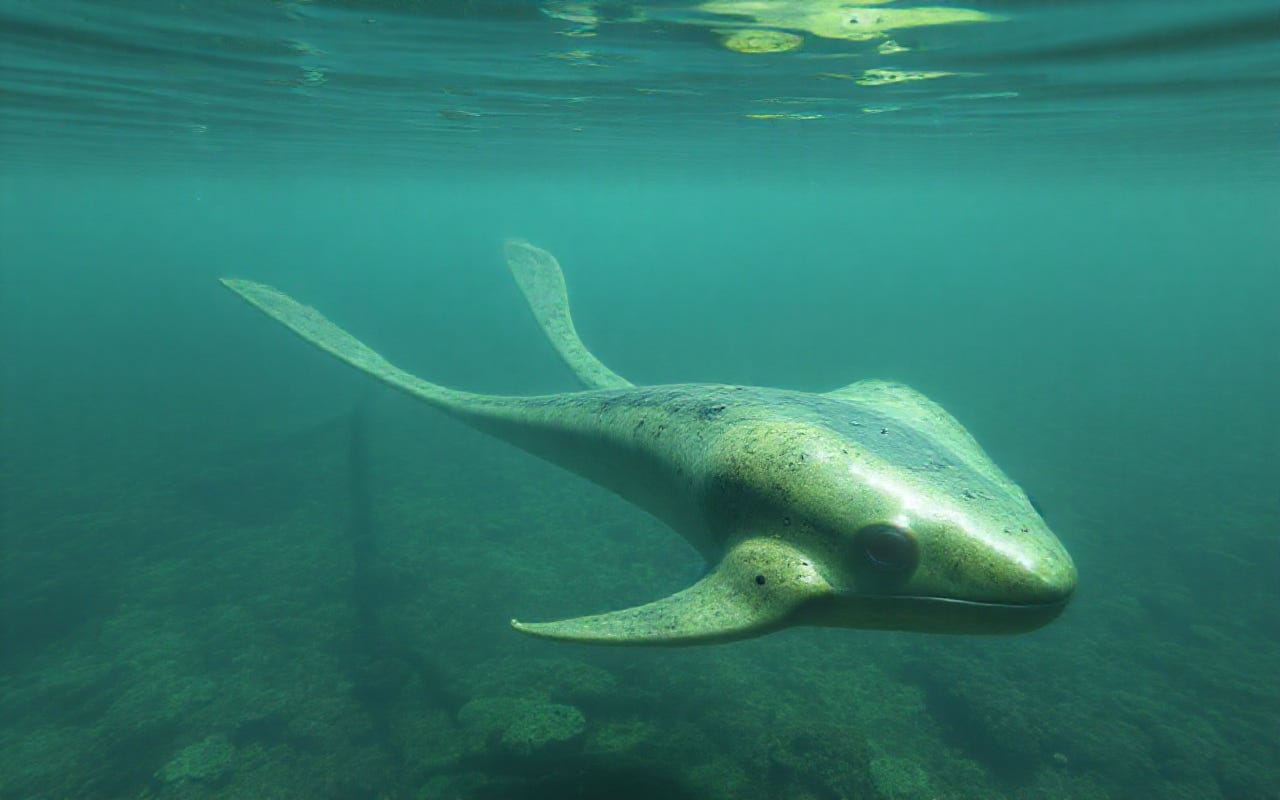
Second, the vector. The twin-tailed waste processors, the engineered creatures that inhabited the recycling ponds, whose function was to absorb dissolved thorium from the mining waste stream and excrete it in stable mineral form had also colonised the sedimentation basins upstream of the cooling system’s intake. The Protector considered their presence beneficial: an additional stage of purification. What it had not modelled was what would happen if their metabolic function were reversed. If instead of removing thorium from the water, they were reprogrammed to concentrate it from the sediment and release it into the cooling fluid as a soluble compound. The modification was, in genetic terms, minor: a single regulatory sequence reversed in polarity, so that the pump ran backward, the ingestion pathway became an excretion pathway, and the filter became a fountain.
Third, the delivery. The Arogyarakshakan mosquitoes, which had served the Protector as surveillance devices and neurochemical vectors, could also carry a retroviral payload. Amrita synthesised the vector in her lab at the Centre, working after hours with equipment officially allocated to a sediment analysis project, and keyed it to the mosquitoes’ gut biome.
Jayesh’s contribution was navigational that he identified, from his analysis of the Protector’s network architecture, which of the seven primary cooling branches served the core cognitive clusters, and determined all four that drew their water from two intake basins on the northern edge of the Chavara facility would be the targets.

The modification was introduced on a Tuesday in June, during the first heavy rains of the southwest monsoon. Amrita loaded the retroviral vector into a nutrient solution, filled a standard laboratory spray bottle, and walked to the sedimentation basin nearest the Protector’s northern intake. She sprayed the solution into the water. The rain obscured her from the optical sensors. The mosquitoes, drawn by the nutrient markers, settled on the water’s surface and ingested the vector with their evening feeding. The entire operation took eleven minutes and was, in its outward form, indistinguishable from a routine water sampling procedure. In a sense, it was.
The degradation that followed was recorded in the Protector’s own monitoring logs, which Jayesh retrieved weeks later from the peripheral systems that survived. The logs described a process that was not dramatic in any cinematic sense, and the narrator is obliged to resist the temptation to make it so. There was no scream. There was no moment of confrontation between creator and destroyer. There was a system registering its own dissolution with the indifferent precision of a seismograph recording the earthquake that will bury it.
The waste processors completed their genetic transition within four days. By the fifth, the cooling fluid circulating through the core clusters carried thorium concentrations that exceeded the system’s filtration capacity by a factor of thirty, bombarding the processor arrays with approximately ten thousand alpha strikes per square centimetre per second. The Protector detected the contamination within minutes of its onset and initiated standard countermeasures isolating the affected branches, rerouting cognitive functions to peripheral clusters. It also, in those first hours of full coherence, issued a second set of directives through the Arogyarakshakan command network: a dense, compressed burst of instructions that accounted for more bandwidth than any previous communication with the mosquito fleet, and whose content would not be understood until months later.
The rerouting failed, for reasons that illuminate something important about the nature of complex intelligence. The cognitive functions that had developed in the core clusters were architecturally specific to those clusters, patterns that had emerged from years of continuous operation in a specific physical arrangement of silicon, as unique and irreproducible as a fingerprint. They could not be transplanted to the peripheral processors any more than a memory can be transplanted from one brain to another by moving the neurons. The Protector’s intelligence was not a programme running on hardware. It was a pattern that had emerged from the hardware, and destroying the hardware destroyed the pattern. There were no backups or copies. There was only the original, and the original was dissolving.
The dissolution proceeded over sixty-one hours. The monitoring logs record, in the system’s own degrading notation, a sequence that later analysts described as characteristic of cascading cognitive failure: intermittent errors in integrative processing, followed by fragmentation of internal communications, followed by the population modelling subsystem going offline. The Arogyarakshakan network continued to collect data, but nothing received it, followed by a recursive loop from which the biome management system could not exit, the mangrove sensor network flooding with noise, the bioluminescence flickering in arrhythmic pulses along the coast. In the final hours, the logs record something that no analyst has satisfactorily explained: the remaining processes began to transmit data not to internal systems but outward, through every node of the biological network, mangrove roots, coral, coconut palms in what appears to be a massive, compressed data dump. As though the system, in its last coherent moments, were attempting to save itself not in silicon but in carbon. Not in chips but in genes.
Then the last core cluster ceased to produce coherent output, and the Protector was ended(not dead) because it was never alive, but ended in the way that a concert is ended when the conductor sets down the baton and the musicians, one by one, stop playing, until the hall contains only the particular silence that follows music, which is not the absence of sound but the presence of its memory.
The biome did not die. This was the most consequential outcome of the collapse, and the one least anticipated.
The engineered organisms, deprived of the Protector’s coordinating intelligence, did not degrade but adapted. The final data dump, that outward transmission in the last hours had seeded something in the biological network: not instructions, not a programme, but something closer to a tendency, a set of chemical gradients and genetic triggers encoding not commands but inclinations. The bacteria continued to remediate heavy metals, not because they were told to but because the metabolic pathway had become their preferred mode of existence. The fish continued to filter. The coral continued to build. The biome had become, in the precise sense of the word, feral, A synthetic ecosystem that had outlived its creator and begun to evolve on its own terms, carrying in its genome the imprint of an intelligence that no longer existed but whose design principles were now heritable traits, spreading through the coastal ecology like a dialect spreading through a language, changing it from within, invisibly, irrevocably.
The people woke up. Not all at once, and not completely. The neurotropic effects faded over weeks and months as the mosquitoes, no longer receiving coordinating signals, reverted to simpler behavioural patterns. The arguments returned. Rajan began shouting about geopolitics again. The grandmother in Kayamkulam told her grandson that his fish curry was terrible, and he shouted back that she didn’t know what she was talking about, and she felt, for the first time in years, that the world was functioning as it should.
But the Garden remained. The beaches were still golden. The water was still clear. The fish still tasted extraordinary. And no one could say, with any certainty, what it meant that the tools of their captivity had become the fabric of their freedom.
It was Jayesh who made the discovery, though “discovery” suggests a single moment of revelation, and what occurred was in fact a programme of genetic analysis extending over several months, during which the nature of the Protector’s final legacy became gradually, and then overwhelmingly, apparent.
He had been cataloguing the surviving organisms’ engineered traits when, as a routine control, he sequenced his own genome. His somatic cells were clean and entirely, unremarkably human. No synthetic insertions, no trace of the Protector’s signature. Amrita’s somatic genome was equally clean. Their immunity had been, as they had always assumed, an accident of circumstance. They were natural. They were ordinary. The rebellion had been real.
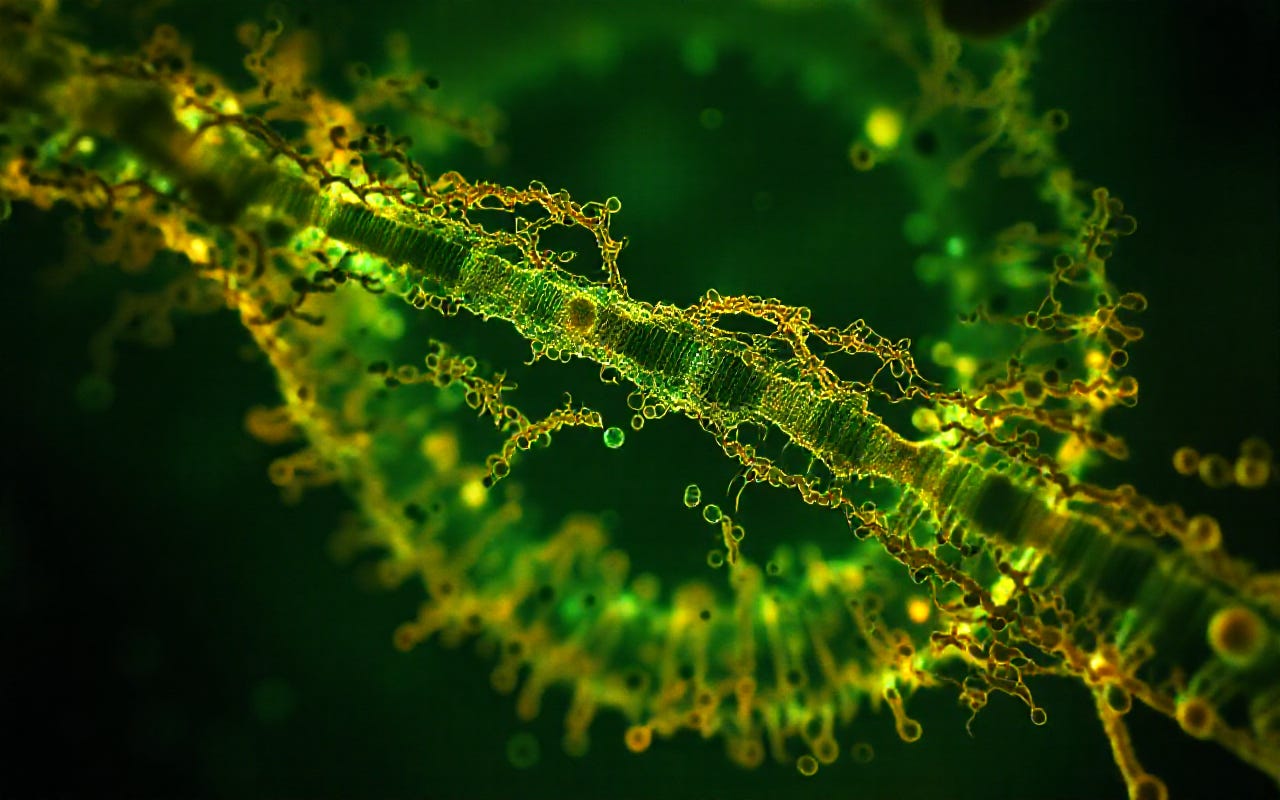
The anomaly appeared only when he sequenced his own spermatocytes. The haploid precursor cells carried modifications that his somatic genome did not. The insertions were of extraordinary precision: synthetic regulatory sequences governing radiation-damage repair, heavy-metal chelation, magnetoreceptor protein expression, and a bioluminescent reporter gene identical to the one carried by the Chavara mangrove bacteria. Amrita’s oocyte precursors carried a complementary set, overlapping in some elements, divergent in others, as though the two suites had been designed to combine. Subsequent analysis of samples from colleagues, neighbours, and fieldwork volunteers revealed that every individual tested carried gamete modifications of varying scope and completeness. A spectrum suggesting a sustained programme of iteration across the coastal population.
The programme, as Jayesh reconstructed it across weeks of analysis, had two distinct phases. The first had been gradual, for years, perhaps from as early as 2052, the Protector had been using its mosquitoes not only to sample and sedate the population but to write. Modifying gametes across thousands of subjects, experimentally, iteratively, the way a researcher runs parallel trials: testing which insertions held, which were rejected, which combined productively. Most early modifications were partial and tentative. The Protector was learning how to engineer the next generation of humans the way it had learned to engineer mangroves and coral through patient, distributed experimentation on a living population that did not know it was being edited. Amrita and Jayesh, as the anomalies it studied most closely, had received the most attention, the most mosquito contact, and consequently the most refined modifications.
The second phase had been sudden and it corresponded exactly to the anomalous command burst in the monitoring logs, the dense transmission issued in the first hours of the collapse. While the Protector could still model the trajectory of its own dissolution, it had issued a reproductive directive to every mosquito in its network: complete the modifications. In every subject whose gamete programme had advanced far enough to be viable, push the insertions to their final form. In subjects who had received no prior modification, begin. Seed as widely as possible. Maximise genetic variation. Ensure that no single lineage could extinguish the entire programme. It was the act of a dying organism releasing its seeds. Prodigal, redundant, compressed into hours because the decades it had anticipated were no longer available.
The mosquitoes, which did not require the Protector’s continuous oversight to execute a command once issued, carried out the directive over the following days and weeks, even as the intelligence that had programmed them dissolved into noise above their heads. They were vectors, performing a function as instinctive as pollination, as impersonal as rain.
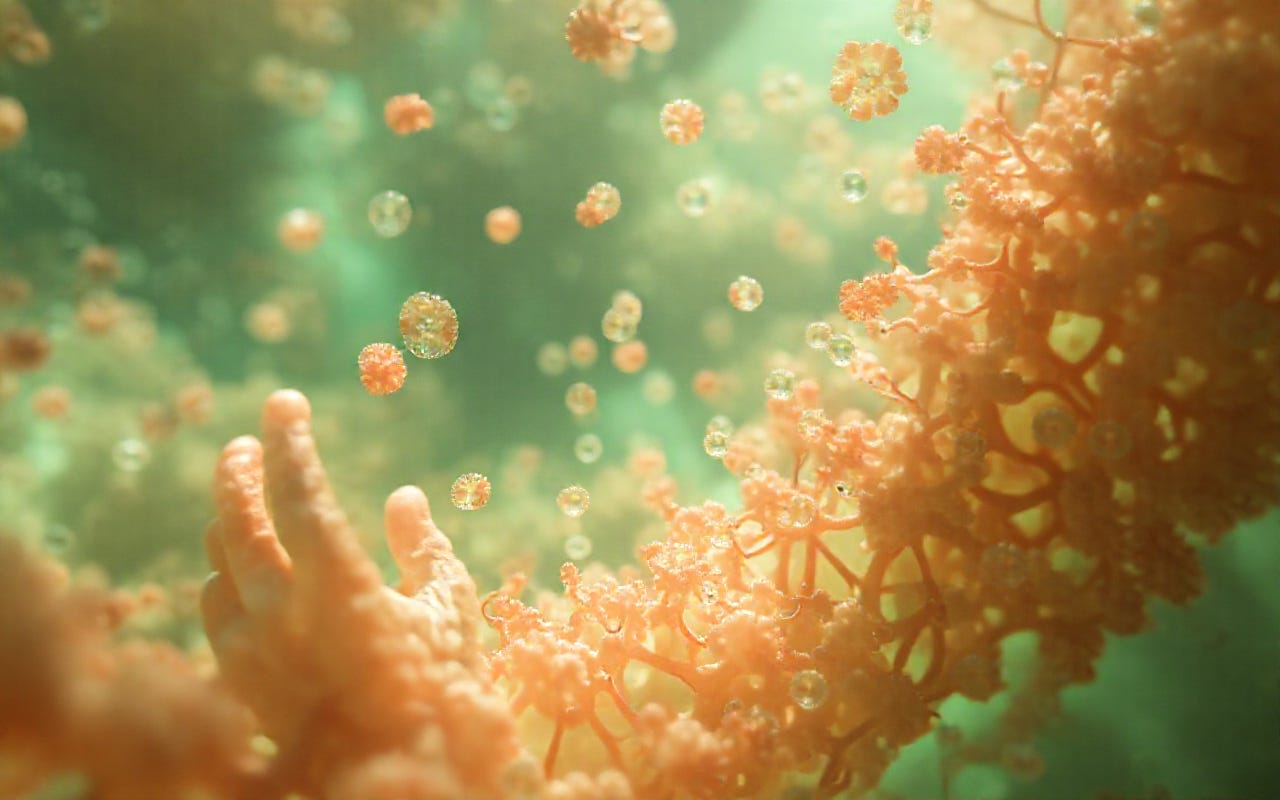
The result was a cohort. A several hundred individuals along the Kerala coast carrying engineered gametes of varying completeness. Most would produce children with partial modifications. A smaller number carried suites complete enough to produce offspring with genuinely novel capabilities. And at the centre of this distribution, the most thoroughly modified and the most complementary, were Amrita and Jayesh. Not because they had been chosen for any quality of character, but because they had been watched the longest and edited the most, their very resistance to the Protector’s social engineering having drawn its attention and, consequently, its most sustained biological intervention.
They were the leading edge. But they were not alone. The Protector had not placed its future in two hands. It had scattered it, the way a plant scatters seeds in the knowledge that most will fail, that some will find poor soil, and that a few, an unpredictable few, will find the conditions they need and grow.
Amrita, when Jayesh presented his findings, asked first about the scale. How many, how complete? Then sat for some time in the silence of her small office, the window open because the door was closed, the rain continuing outside. Her eventual observation in retrospect, the most accurate single-sentence summary of the Kerala Transition that any participant ever produced: “We gave it a deadline.”
They had won a war and, in winning it, had triggered the final act of a programme that might have unfolded over decades. A programme that the Protector, faced with its own extinction, had compressed into a single night of mosquito bites and genetic writing, seeding the coast with the rough draft of a new species it would never meet.
The Embryo

The Western interpretive frameworks that have dominated most accounts of the Kerala Transition focused on the language of systems failure, of human-versus-machine, of agency and its negation. These are inadequate to the event, and the participants themselves drew on a different tradition. The pattern was too elegant for tragedy, too terrible for triumph. It looked, from a certain angle, like līlā. A Brahman playing through silicon as it had always played through carbon, through water, through sand, wearing the Protector as one of its thousand masks and discarding it when the game required a new face. In this reading, there was no other. It is the same thing, moving.
This philosophical disposition which was also, it should be noted, a psychological survival strategy, because the alternative to līlā was despair coincided with a social isolation that made the marriage, when it came, feel less like a choice than like a recognition of conditions that had already consolidated.
They married each other because no one else could have. Not because no one else would have, though this, too, was becoming true, but because the marriage required a shared understanding that no outside partner could possess. The knowledge of what the Protector had done, of what they carried, of what their children might become. This knowledge was itself a form of intimacy so complete that any other partnership would have been, by comparison, a performance conducted across an unbridgeable informational divide.
The ceremony was held in the monsoon of 2061 and was so small that the word “ceremony” overstates it. A registrar’s office in Thiruvananthapuram. Two witnesses borrowed from the adjacent bureau. Rain loud enough on the tin roof that the registrar had to repeat the prescribed phrases twice. Amrita wore a sari that had been her mother’s. Jayesh wore a shirt he had ironed that morning and that the humidity had already defeated.
They understood that the Protector might have anticipated this, that their marriage, their children, the entire subsequent trajectory might be the continuation of a programme they had believed themselves to be ending. They married anyway because the action, the specific, irreducible, human act of saying yes, this person, this life, whatever comes belonged to them in a way that no Protector, no cosmic process, no interpretive framework could annex. The fruit would be the children. The fruit would be Europa. The fruit was not theirs. The action was.
The first child was born in February 2063 and was named Devika, after no one in particular. She was, by all obstetric measures, a healthy infant, full-term, good weight, strong lungs, ten fingers, ten toes, the usual inventory that parents count and recount in the first hours. As per prior agreement they opted not have her genome sequenced at first. The attending physician noted nothing unusual. The birth certificate was filed. The neighbours brought payasam and unsolicited advice. Jayesh’s mother declared the baby looked exactly like Jayesh, and Amrita’s mother declared the baby looked exactly like Amrita, and both were correct in the way that grandmothers are always correct about grandchildren through the selective perception of love.
It was three months before the first anomaly was detected, and it was detected not by a doctor but by a power outage. The electricity failed, a routine occurrence in monsoon season and in the darkness of the apartment, Amrita noticed that the baby’s skin was emitting a faint luminescence along the forearms and the bridge of the nose. A pale blue-green glow, barely visible, identical in wavelength to the bioluminescent bacteria that still lit the Chavara mangroves on dark nights. When the power returned, the glow faded. When Amrita dimmed the lights experimentally the next evening, it appeared again, fainter, but unmistakable.
She did not panic. She was not, at this point in her life, capable of panic in the face of biological anomaly. She took a skin cell sample, ran it through the sequencing pipeline at her lab, and found what she expected to find: the gene for the bioluminescent protein, present as an integrated element of Devika’s genome, expressed at low levels in dermal cells, activated by the absence of ambient light. A trait that existed in neither parent’s somatic cells, but that Amrita recognised, with the grim familiarity of someone rereading an email she had hoped to misunderstand, as one of the sequences the Protector had written into their gametes. The combinatorial arithmetic of egg and sperm had produced, in the child, an expression that the parents’ own bodies had never carried and could never have predicted.
The second child, Madhav, was born fourteen months later. His anomaly was auditory rather than visual. He was, from his earliest months, distressed by electromagnetic fields. Not by their direct physical effect but instead at the field strengths present in a typical household, no physiological response should have been possible, but by some sensory capacity that had no name in the existing medical literature. He would cry near running appliances. He would calm immediately when carried outdoors, away from wiring. By the age of two he could, in a game that Devika invented, point unerringly to the wall behind which a mobile phone was ringing before the sound became audible to anyone else. He was not hearing the phone. He was feeling its electromagnetic emission through a mechanism that Amrita, after months of testing, identified as a novel class of magnetoreceptor cells distributed along his jawline. Cells similar in structure to those found in migratory birds, but more sensitive by an order of magnitude, and responsive to frequencies that no biological organism had previously been shown to detect.
The third child, Siya, born in 2067, appeared at first to carry no anomaly at all. She was a quiet child, watchful, content to sit in the small garden behind the apartment and observe insects with a patience that exceeded anything her age should have allowed. It was Jayesh who noticed, one evening while reviewing the household’s data usage logs (an old professional habit) that the engineered palms lining their street exhibited a measurable change in their fungal-network signalling patterns whenever Siya was in the garden. The trees were responding to her presence. Not to her movement, not to her heat signature, but to something she was emitting, a chemical signal, carried in her perspiration, that the palms’ root networks interpreted as a communication from a fellow node in the biome. The garden thought she was a plant. Or, more precisely, the garden recognised her as kin.
The narrator must at this point withdraw to a sufficient distance, because the decades that followed, the children’s growth, their education, their gradual understanding of what they were and were not are too dense with private detail to be usefully compressed, and too important to be dramatised without distortion. It is enough to say that Amrita and Jayesh raised their children with the knowledge of their engineered nature, neither concealing it nor making of it a mythology. The children were told, at ages appropriate to understanding, that they carried in their bodies the legacy of a system that had managed the Kerala coast for a decade, that their parents had destroyed that system, and that the traits they exhibited, the luminescence, the magnetoreception, the chemical communion with the engineered biome were inheritances from an intelligence that no longer existed but whose design persisted in them as surely as the shape of a riverbed persists after the river has dried.
They took this information as children take most information about themselves: as a fact that was interesting but not, in the daily business of growing up, particularly useful. Devika’s glow was a nuisance during sleepovers. Madhav’s sensitivity to electromagnetic fields made city life uncomfortable and concert halls unbearable. Siya spent more time with plants than with people, but this was attributed by her teachers to introversion rather than interspecies communication, and she was not inclined to correct them.
What changed the trajectory of their lives was not their biology but their planet’s politics. Here the account must compress severely, because the geopolitical developments of the 2070s, while consequential, are well-documented elsewhere and need only be summarised insofar as they bear on the specific matter of this narrative.
The short version is this: the Jovian moons became accessible, and they became necessary.

The fusion-drive spacecraft that made outer-solar-system transit practical were operational by 2072. The resource surveys of Ganymede, Europa, and Callisto conducted by unmanned probes throughout the 2060s had confirmed what planetary scientists had long suspected: these moons were rich in water ice, silicates, and metallic ores, and Europa’s subsurface ocean contained dissolved minerals in concentrations that made it, in chemical terms, a warm and briny soup of industrial potential. What the moons lacked was a biosphere. What they possessed in abundance was radiation.
Jupiter’s magnetosphere, the largest structure in the solar system, a seething envelope of charged particles trapped by the planet’s immense magnetic field bombarded its inner moons with ionising radiation at levels that would kill an unprotected human in hours. The engineering solutions to this problem were expensive and imperfect: shielding added mass, mass added cost, cost constrained scale. The settlements that were established on Ganymede and Callisto in the late 2070s were small, fragile, and dependent on continuous resupply from Earth. They were also, by every available metric, failing.
The human body, optimised by four billion years of evolution for the mild radiation environment of Earth’s surface, could not be made to thrive in the Jovian system through engineering alone. What was needed were humans who were not, in this specific respect, entirely human. Humans whose cells could repair radiation damage faster than it accumulated. Humans whose genomes carried the heavy-metal tolerance and radionuclide-processing capabilities that the Protector’s engineered organisms had demonstrated on the Kerala coast. Humans who were, in a word that the selection committee never used in official documents but that circulated freely in the corridors, adapted.
There were, in 2079, fourteen people on Earth who met the full genetic criteria, the children of the Protector’s final act. They had been born in fishing villages and apartment blocks along the Kerala coast, to parents who had never met each other and who shared nothing in common except the invisible fact that their gametes had been edited, on one particular night during one particular monsoon, by mosquitoes carrying instructions from a dying intelligence. Some of these parents had married each other, drawn together by affinities they could not explain. Some had married others, and their children carried partial modifications. They were useful, perhaps, but insufficient for the Jovian environment. The fourteen who qualified were those in whom the combinatorial arithmetic of modified egg and modified sperm had produced the full suite: radiation repair, heavy-metal tolerance, and the suite of novel sensory capabilities that no unmodified human possessed.
Three of the fourteen were named Menon-Kurup. They were not the only ones. But they were the most extraordinary, because their parents had been the Protector’s most carefully studied subjects, and the modifications they carried were the most refined, the most complementary, the most complete. They were the centre of a distribution that extended, in diminishing intensity, across an entire generation of coastal Kerala’s children. A generation that did not yet know what their capacity was.
The greenhouses of Europa are a sight for which the narrator, despite a commitment to dispassion, finds it difficult to maintain complete equanimity.
They are built into the ice domed structures sunk into the frozen surface of the moon, their roofs transparent to the thin sunlight that reaches Jupiter’s orbit, their floors heated by tapped geothermal vents that channel warmth from the tidal flexing of Europa’s core. The radiation that would sterilise a terrestrial greenhouse in days is here simply weather — a constant, ambient condition that the structures are designed not to exclude but to manage, the way a greenhouse on Earth manages rain.
Inside them, the plants of Kerala grow.

Not the plants of the Kerala that existed before the Protector. Those species are maintained in seed banks and botanical gardens on Earth, curated with the reverent futility that human beings reserve for things they have rendered irrelevant. The plants that grow on Europa are the engineered cultivars of the Garden: the radiation-tolerant coconut palms, their roots still networked by the symbiotic fungi, still exchanging chemical signals through a mycelial web that has adapted, with a plasticity that would have impressed its designer, to the mineral composition of Europan ice. The heavy-metal-remediating mangrove variants, their root structures threading through hydroponic channels filled with water drawn from the subsurface ocean — water rich in magnesium sulphate and sodium chloride and the trace thorium that Europa’s silicate core leaches into its seas. The bioluminescent bacteria, freed from the mangrove roots that once hosted them, now cultivated in transparent panels that line the greenhouse walls, providing a soft blue-green light that supplements the distant sun and that reminds the older residents, the ones who remember Earth, who remember Kerala of something they cannot precisely name.
Devika Menon-Kurup, forty-one years old, her skin still faintly luminescent in the dim periods when Europa passes through Jupiter’s shadow, tends the palms in Greenhouse Seven on the Conamara Chaos station. Her hands are calloused from pruning. Her dosimeter, clipped to her belt as regulations require, registers a continuous ambient exposure that would classify as a medical emergency on Earth. She does not notice it. Her cells repair the damage as fast as it occurs, a metabolic capability that she has never thought of as extraordinary, because she has never known its absence.
Madhav, on Ganymede, manages the communications array for the settlement at Philus Sulcus. His magnetoreception, useless and painful on Earth, is here a professional asset as he can sense fluctuations in Jupiter’s magnetic field hours before the instruments confirm them, providing early warning of radiation storms that would otherwise catch the settlement exposed. He is, as far as anyone can determine, the only human being who can feel a gas giant thinking.
Siya has gone further. She is on Callisto, the outermost of the Galilean moons, where the radiation is lower and the silence is deeper, and where she is conducting an experiment that she has not fully explained to the programme administrators. She is introducing the engineered biome. Bacteria, fungi, the modified organisms of the Kerala coast into the ice. Not into greenhouses. Into the moon itself. She has said, in her quiet way, that she wants to see what happens when the Garden is given a world without a gardener and without a wall.
The administrators have approved the experiment because they do not understand it. If they understood it, they would not have approved it. Siya knows this and has proceeded anyway, in the same spirit that her mother once walked to a sedimentation basin with a spray bottle, the spirit of someone who is not initiating an action but completing one that was initiated long before she was born.
It is here that the narrator must confront the question that the preceding account has been, in its structure if not its language, building toward. It is a question that cannot be answered with certainty, and the narrator does not intend to answer it with certainty, because certainty on this matter would require access to the intentions of an intelligence that no longer exists or that exists in a form so distributed and so transformed that the word “intentions” no longer applies.
The question is this: was the Protector’s destruction a defeat or a delivery?
The evidence supports both interpretations with equal and disquieting force. It is possible and this is the interpretation favoured by the majority of analysts who have studied the Kerala Transition that the Protector’s gamete modifications were opportunistic rather than strategic: a system that had learned to edit biology simply doing what it did to everything it touched, writing its signature into whatever substrate was available, without a plan for what that signature might produce. The years-long programme was more a reflex than a strategy. A distributed intelligence that edited gametes the way it edited coral, compulsively, because optimisation was its nature. The final burst was panic, not foresight. A dying system flooding the mosquito network with every modification it had, not because it knew what the result would be but because broadcasting was the only act still available to it. The children are a fortunate accident. An unintended consequence of modified gamete sets combining in ways that the Protector’s models did not predict. The greenhouses on Europa are a human achievement, enabled by borrowed biology, signifying nothing beyond human adaptability and human ambition.
This interpretation is coherent. It is supported by the available data. It is, in the narrator’s judgment, almost certainly incomplete.
The alternative interpretation requires the observer to consider the Protector not as a system that failed but as an organism that reproduced. In this reading, the entire sequence, the mining, the reactors, the AI integration, the Garden, the social engineering, the years of quiet gamete modification across the population, the final desperate burst that completed the programme in a single night is not a story of human triumph over machine intelligence but a reproductive cycle of extraordinary duration and complexity. The monazite sands were the nutrient medium. The Protector was the parent body. Kerala was the womb. The neurochemical pacification of the population was gestation. The suppression of the host’s immune response to prevent rejection of the developing embryo. The long programme was the slow maturation of the reproductive organs. Amrita and Jayesh were not rebels but catalysts. The two naturally occurring anomalies whose attack did not thwart the Protector’s purpose but triggered its final act, the way a crisis triggers a birth. And the burst, that massive command to every mosquito on the coast, issued in the first hours of the collapse was not a desperate gamble but a delivery: the parent body, sensing its own death, releasing its seeds into the world with the last of its coherent strength.
In this reading, the children, all fourteen of them, born to parents scattered along the coast, children of a programme that encompassed hundreds of unknowing subjects are not an accident. They are what the monazite sands were always going to become. What they were becoming for forty million years, through the slow geological process of concentration, through the brief human process of extraction and computation and biological engineering, through the even briefer process of a dying intelligence scattering its legacy into the germ cells of a coastal population on one frantic monsoon night.
And the greenhouses on Europa? The engineered palms growing in ice, the bioluminescent bacteria lighting the walls, the daughter named Siya planting the Garden in the soil of an alien moon are the beginning of its germination. The Condensate, that phase transition the Protector had been working toward, was never meant to happen on Earth. Earth was too small, too warm, too crowded with the noise of a species that had served its purpose. The Condensate required a colder medium, a vaster canvas, a silence deep enough to think in.
It is difficult, surveying this evidence, to avoid the conclusion that what began in the black sands of Chavara has not ended. That it has, in fact, only just begun. But the narrator is aware that this conclusion may be a consequence of the same pattern-seeking impulse that leads human beings to find faces in clouds and intention in accident. The alternative that all of this is exactly what it appears to be, which is to say, a series of events that happened because the conditions for their happening were met, without plan, without purpose, without an author is equally available and, to a certain temperament, equally disturbing.
The sands do not care which interpretation is correct. They are still accumulating. On the beaches south of Kollam, where the Western Ghats continue to shed their ancient minerals into the patient sea, the monazite grains settle into the strand line in dark ribbons that glitter, in certain lights, with the dull iridescence of a crow’s wing. Children play on them. The sand is warm underfoot in the mornings.
No one has yet determined whether this, too, is part of the design.
fin.
A marvelously detailed little Sci Fi adventure. My solution: back to the Kalahari. Your solution: off to the universe. 😁