
This essay is a sibling to The Divinity and the Factory Farm. The first one tries to understand whether the artist is allowed to use these materials. This one says and here is why one would, right now. Together they make a pair.
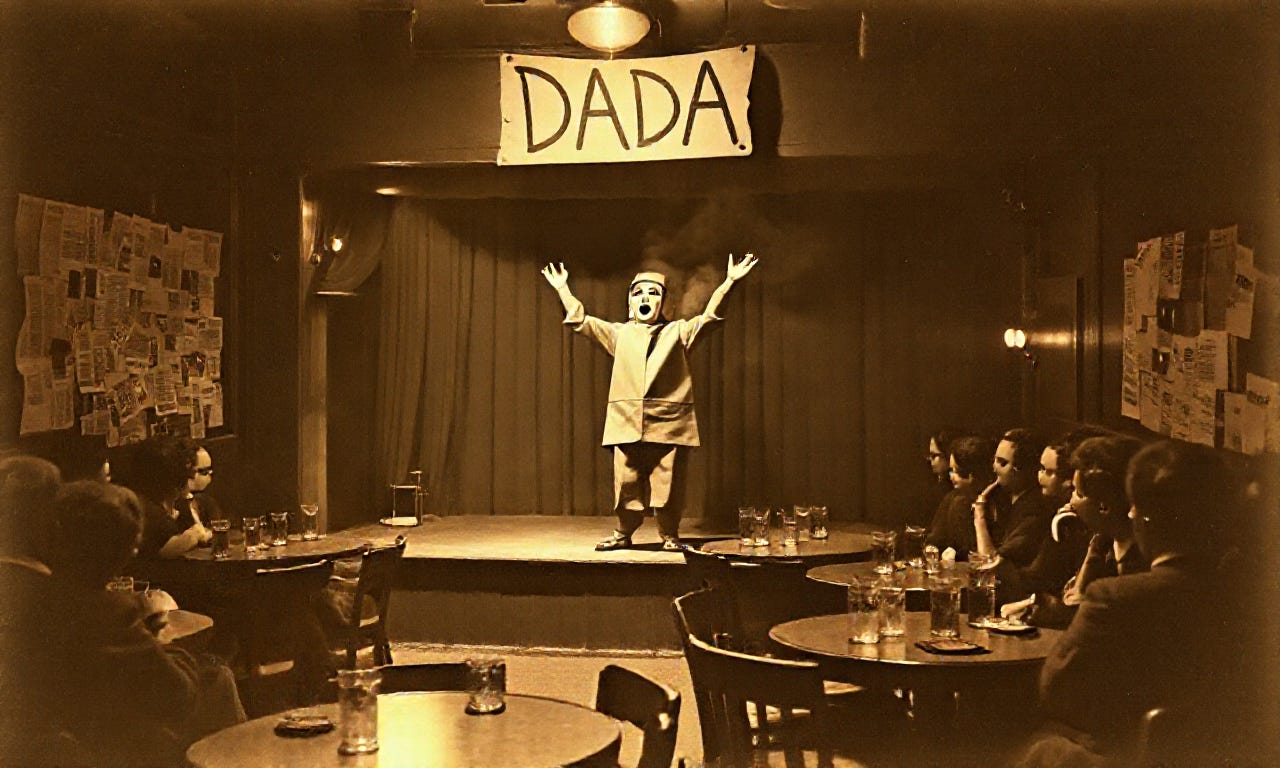
The Dadaists made art that refused a civilization capable of producing trenches, machine guns and mustard gas. Beauty was not the response that refusal demanded.
In 1916, in a Zurich cabaret, a small group of artists watched Europe industrially destroy itself a few hundred miles east and decided that the rational, the coherent, and the well-made were complicit. The same civilization that produced Beethoven also produced novel war machines. Both came out of the same factory of reason. So they cut up newspapers. They wrote sound poems with no words. They mocked the institutions of art and the institutions of state in the same breath. The work was supposed to be ugly because beauty itself had become complicit.
This might be emerging again.
The civilization producing generative AI is also producing the live destruction of cities, with the populations still inside. The collective response is that we have learned to live with it.
The shape of the death has also changed. The Dadaists faced industrial killing that arrived as numbers. Shells fell across a sector and machine guns swept a field. Which body died was a question of where each one happened to be standing.

The killing civilization produces now is no longer statistical. A soldier in a trench hears a screeching, demonic electro-mechanical sound approaching from somewhere far above. The pitch climbs as the thing closes. Somewhere else in the world, a person watches that soldier through a camera the soldier cannot see and steers the device toward him with a thumbstick. The body cannot answer the incredible homing speed of the quadcopter. The killing has been addressed personally, and the soldier sees his last seconds rendered as a video feed in someone else’s headset.

In a world of madness, madness is the medium.
This is the moment in which we are asked to consider whether using AI is ethical.
The Dadaists used the printing press. They took the materials civilization had produced and shaped them into work civilization could not metabolize. The point was never to find pure materials, only to apply them with intent strong enough to break their original purpose.
A synthesizer patch is a configuration of modules. A raw signal enters one side as a carrier wave and emerges from the other side modulated, filtered, distorted, shaped beyond recognition. Whatever the patch produces is the artist’s work, built out of a wave that was nothing in particular before the patch got to it.
Generative AI as a carrier wave was extracted from the digital commons without permission. It was trained by corporations pursuing dominance and runs on data centers that drink rivers and gobbles megawatts.

What comes out the other side of the patch is what the artist did with the model, which is a different thing from what the model would have produced on its own. If the patch is built right, the system that produced the carrier wave would not recognize what was made from it.
Whether it is enough is a different question.
I keep asking whether this is defiance or is this the singularity arriving disguised as work? Are we cutting up newspapers in Zurich while the trenches fillup or are we humming along while the abyss takes us?

Some moments do not offer the artist a clean choice between resistance and complicity, only the choice between making something with the materials at hand or making nothing. The output may turn out to be defiance, decoration, or the singularity arriving cleverly disguised as art.
The honest answer is to keep building the patch and find out.