
We remember the dead man’s voice.
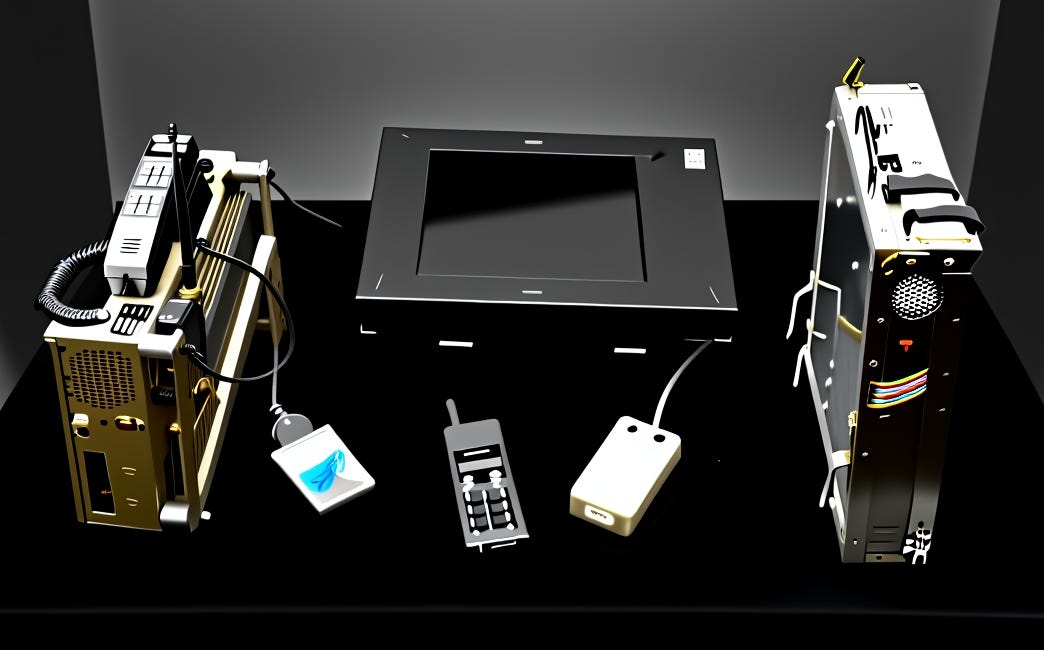
Stephen Hawking’s synthesizer — the one with the flat, faintly American accent that became as recognizable as the wheelchair — ran on a voice that was never his, and belonged to no living person by the time you and I heard it. It was Dennis Klatt’s. Klatt was an MIT researcher who recorded his own speech in the early eighties as the raw material for a synthesis algorithm, and who was losing his own voice to thyroid cancer while he built it. He died in 1988. By then Hawking had already adopted the voice, and he would go on speaking in it for the next three decades.
He needed it because in 1985 he lost his own voice entirely. Pneumonia in Geneva nearly killed him; the emergency tracheotomy that saved his life took his speech for good. What replaced it was a system that let him select letters and preprogrammed phrases one at a time. With practice, he could produce about twenty words a minute. Most people speak around a hundred and fifty. Every sentence Hawking uttered in public for the rest of his life was assembled at roughly a seventh of conversational speed, one deliberate choice after another.
He was offered faster, and he was offered smoother. The hardware aged toward obsolescence; the company that made the voice was absorbed and the parts ran out; his team spent years keeping that exact voice alive — hunting down old source code, rejecting modern recreations that came close but were not quite it. When Intel built him a new interface in 2014, with better prediction and faster input, a reporter asked whether the voice itself would change. The engineer said no: Hawking considered it his own personal voice and did not want it touched. The museum that holds the system today puts it more bluntly. Over the years, he refused offers to “humanise” it.
The upgrade was pitched as making the voice more human. Hawking grasped that humanising the voice would have de-humanised him — that the robotic flatness everyone else heard as a limitation was, by then, the most personal thing he owned.
When he died in 2018, the voice went into a museum. The Science Museum in London holds the hardware now. The voice itself survives in recordings.
This is the cleanest example I know of what assistive technology can be. The synthesizer did not speak for Hawking. It did not guess what he might want to say, or round his words off into something easier to hear. It said, one painstaking selection at a time, exactly what he had chosen — twenty words a minute, in a borrowed voice he had decided to keep. The prosthetic and the person had fused so completely that “improving” the prosthetic would have erased the person. Improving the voice would have erased two.
This is the essay’s question.
The cultural objection to AI-sounding prose is usually framed as an aesthetic complaint, or an authenticity complaint, or an authorship complaint. I think it is more useful to frame it as a complaint about operating mode.
A screen reader does not improve on what is on the page. It renders it. A brain-computer interface that decodes neural signals into synthetic speech does not improve on what the user is trying to say. It transmits it. A communication board that lets a non-speaking child build sentences from icons does not finish the child’s thought. It supplies the words the child is reaching for and gets out of the way. All of these are AI. None of them is in the basin.
A large language model in default mode does something else. It receives a request and produces fluent output. The output is not yours, not in the way the synthesizer’s voice was Hawking’s. The output is the model’s, drawn from the model’s training distribution, smoothed toward the model’s average. The fluency is the giveaway. Real voice is not fluent. Real voice has tics, repetitions, sentences that begin with And, paragraphs that turn mid-thought, hedges that mean something. What the critical reader is recoiling from when they say this sounds like AI is not artificiality. It is averageness. It is the specific quality of having been generated by something that has read everything and absorbed the central tendency of all of it.
Two operating modes. One machine.
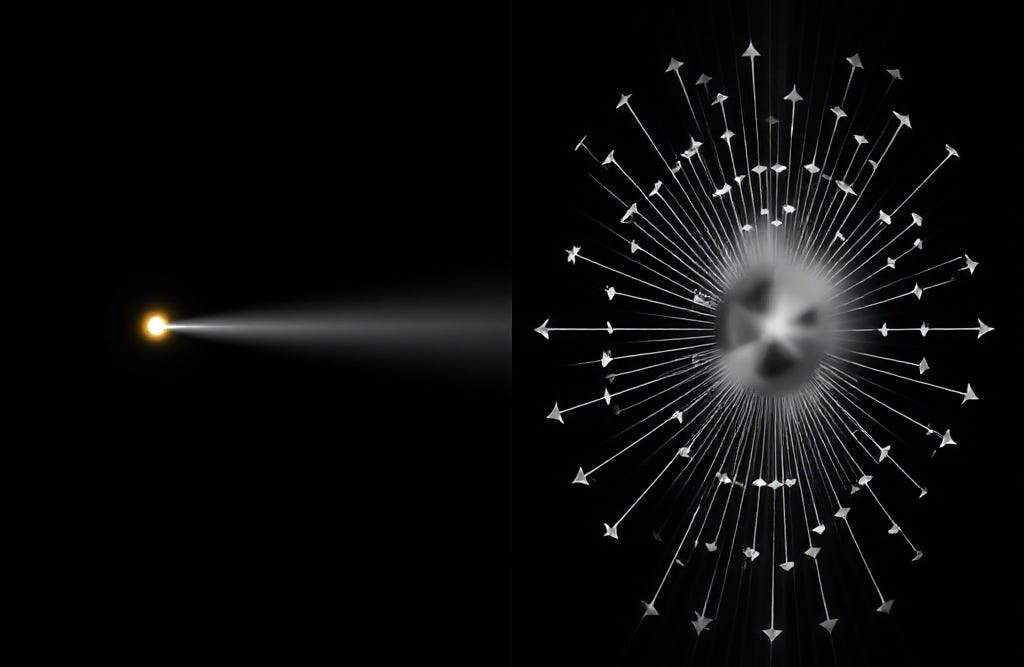
The cases I have named so far — Hawking, screen readers, BCIs (Brain Computer Interface), communication boards — are all cases where the user cannot do the thing the technology assists with. They cannot speak but the synthesizer speaks for them. They cannot see, so the screen reader reads to them. The technology fills the legibility gap.
There is a quieter case still, and it is the one that shows the fork most cleanly. A writer with low vision is not short of words or intent. What is degraded is the loop — the ordinary act of writing a sentence, seeing it, and revising it against what you see. Sight of your own page is how you check whether the words match the thing in your head, and when that check breaks, you have not lost something to say; you have lost the ability to confirm you said it. The proxy answer is you can't see well enough to polish it, so the machine will write it for you — which removes the writer from their own work. The prosthetic answer is the eyes on the draft, not the author of it: the machine reads back exactly what is there, flags where a sentence trails off or a word came out wrong, and hands every decision back. One severs the loop and the other closes it.
There is a less legible case the cultural conversation has not caught up to it yet.
Writing, for some people, is itself the disability.
I do not mean this as metaphor. There are minds whose internal cognition runs faster, or more associatively, or in more dimensions, than linear English prose can accommodate. Dysgraphia is real. So is ADHD-pattern thinking that lands a finished argument in one cognitive flash and then has to be unpacked backwards into sequence. So is the experience of writing in a second language with a first language’s syntax pressing against every sentence. So is autism’s tendency to think in systems rather than narratives. For these writers, the conventional written-prose interface is not neutral. It is a specific cognitive demand that some minds meet easily while others meet by paying a tax that fluent writers never see.

For all of these writers — the ones whose cognition outruns the page and the ones who cannot reliably see it — the default LLM operating mode is exactly the wrong tool.. It produces something fluent and entirely unlike what the writer was trying to say. But the same machine, configured differently — configured to preserve idiolect, to ask rather than fill, to suggest rather than replace, to keep the writer’s structure and only repair their orthography, to translate compressed cognition into linear sentences without sanding off the compression — is the screen reader and the BCI and Hawking’s synthesizer. It is assistive. It transmits a voice that already existed and would otherwise have been trapped behind the formatting demands of conventional prose.
The same machine but different configurations based on accommodation.
The architectural decisions that turn the model from proxy back into prosthetic are not really mysterious.
One. The writer’s draft is the source. The model’s role is to suggest, restructure, repair — never to author. The cursor is never the model’s. Every edit returns to the writer for acceptance, rejection, or modification.
Two. Voice is the protected attribute. The model can fix a comma splice. It cannot replace anyway, here’s the thing with however, the salient point is. The model would prefer to. The architecture refuses it.
Three. Scaffolding over substitution. If the model restructures a paragraph, it shows why. If it proposes a phrasing, it offers alternatives. The interaction teaches. The writer’s next paragraph is theirs to write, with skills the prior paragraph built. The opposite design — opaque generation, take-it-or-leave-it output — is the proxy mode in different clothes.
Four. Disclosure travels with the artifact. Readers are told what was assisted, where, and how. Not for shame. For the same reason audiobook narrators get credits and screen readers identify themselves: the listener has a right to know which voice is producing what they are receiving.
None of these is technically difficult. All of them are commercially unpopular, because the proxy mode scales. The assistance is bespoke but the replacement is mass-market. The current generation of consumer LLMs is optimized for the larger market, and that is the basin everyone keeps finding themselves in.
The cultural objection to AI prose, then, is not really about AI. It is about the operating mode the market has selected for. The market wants generative replacement because generative replacement scales to ad copy, customer service, SEO content, and others where averaged fluency is the product. Assistive configuration scales worse and pays less. Of course it has mostly not been built.
But the technology can be built that way. Some of it already has been. The brain-computer interfaces decoding speech for ALS patients are not in the basin. The augmentative communication boards being deployed in special education classrooms are not in the basin. The screen readers describing the visual world to blind users are not in the basin. The same neural-network family that generates SEO copy is, in another configuration, restoring conversation to a child who has never spoken.
Hawking kept his voice because his team built and rebuilt the interface that let him keep it, against the gravity of obsolescence, for thirty-two years. The question for everyone who is not Stephen Hawking, who is using LLMs in default mode because that is what was shipped, is whether we will demand interfaces that let us keep ours.
Or whether we will accept the basin and call it inevitability.
The synthesizer is now behind glass at the Science Museum, alongside the wheelchair and the blackboards. It is shelved as a historical artifact. But what it actually documents is not the history of disability technology. It is a prototype of every interface we have not yet built. A machine that became someone’s voice rather than replacing it. A prosthetic that knew what it was for. A voice that outlived two men and might have outlived a third if the museum had not taken it from the world.
There is nothing technically impossible to build them that way. It is ultimately about the search for optimal human-machine interface design spaces and the personalization potential they offer that scales to everyone economically.