

In our first exploration of the “Unseen Hand,” we argued that the future of AI lies not in the chatbox, but in the invisible systems that guide behavior. We proposed a world where intelligence is ambient.
But how do we build such a world? How do we create a simulation that feels alive rather than scripted?
The answer lies in a radical shift in how we conceive of digital life. To build a living world, we must stop creating pre-recorded behaviors and start cultivating biological impulses. We must move toward an Intent-Based Architecture.
The Fallacy of the Authoritative Server
Most modern simulations operate on a “Command and Control” model. The server is a micromanager; it calculates the exact X, Y, and Z coordinates of every entity and beams them to the client. The client is a puppet, forced to move exactly where told.
This is the antithesis of life.
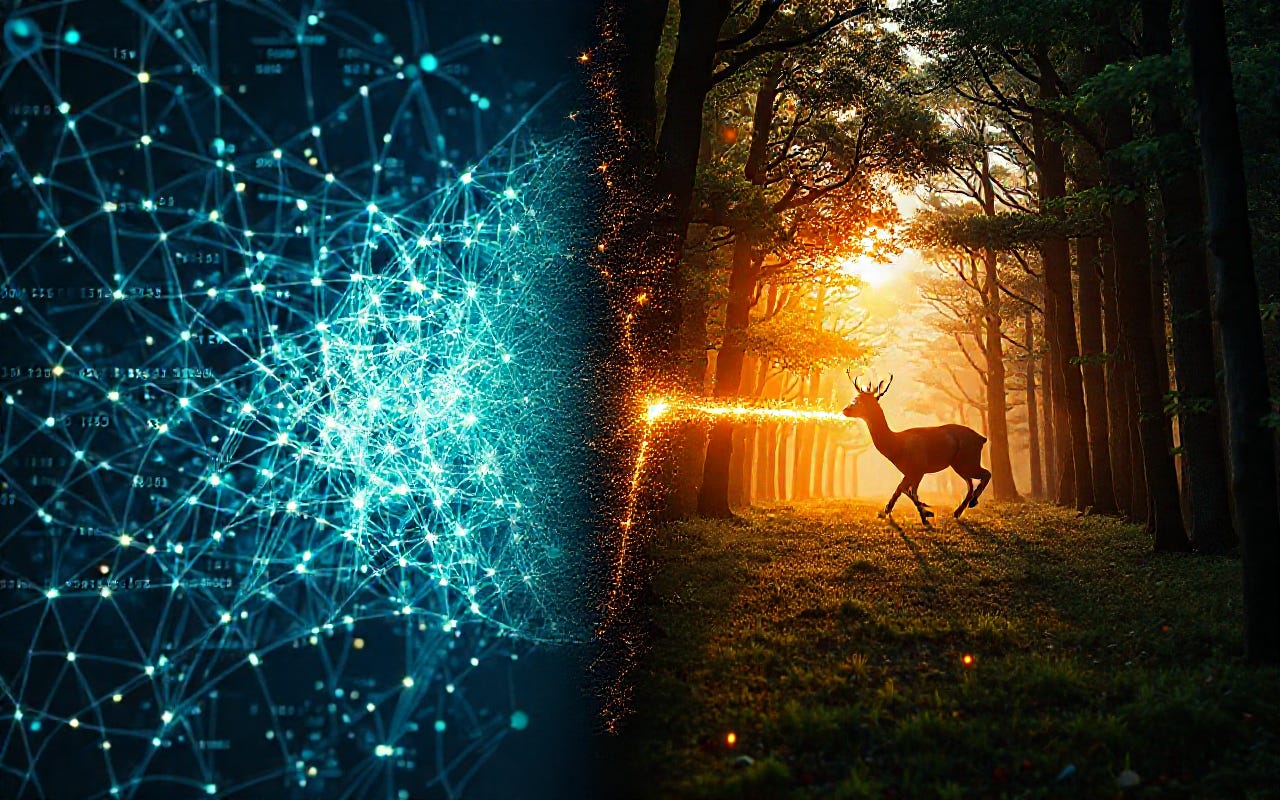
In biology, an organism does not receive GPS coordinates from its brain. A deer does not think, “Move my left leg three inches forward.” Instead, the brain issues an Intent: “I am thirsty; find water.” The body then takes over—the eyes scan the horizon, the muscles coordinate the gait, and the local perception handles the navigation. The brain provides the Will; the body provides the Agency.
To simulate life, we must decouple the two.
The Līlā Model: Distributed Consciousness
Līlā is built on this fundamental decoupling. It splits the world into two distinct layers: The Global Mind (The Server) and the Local Body (The Client).
The Server is the Nervous System. It holds the “Global Truth.” It manages the heavy, slow-moving math of the ecosystem: the depletion of soil nutrients, the birth rates of species, and the chemical balance of the water. It doesn’t care about individual animation frames; it cares about the homeostasis of the system. It issues “Intent Packets”—discrete pulses of desire.
The Client is the Body. It operates at high frequency, rendering the world in real-time. It receives an intent—“You are hungry, and your mood is to graze and be cautious”—and it takes over. The client’s local Agency Engine decides which specific meadow to head towards.
This creates a Distributed Consciousness. The “will” to live is global; the “action” of living is local.
The Necessity of Distribution
One might ask: why not simply run the entire simulation locally? If we want to see a deer move, why not let the client do everything? The answer lies in the difference between a scene and a world.
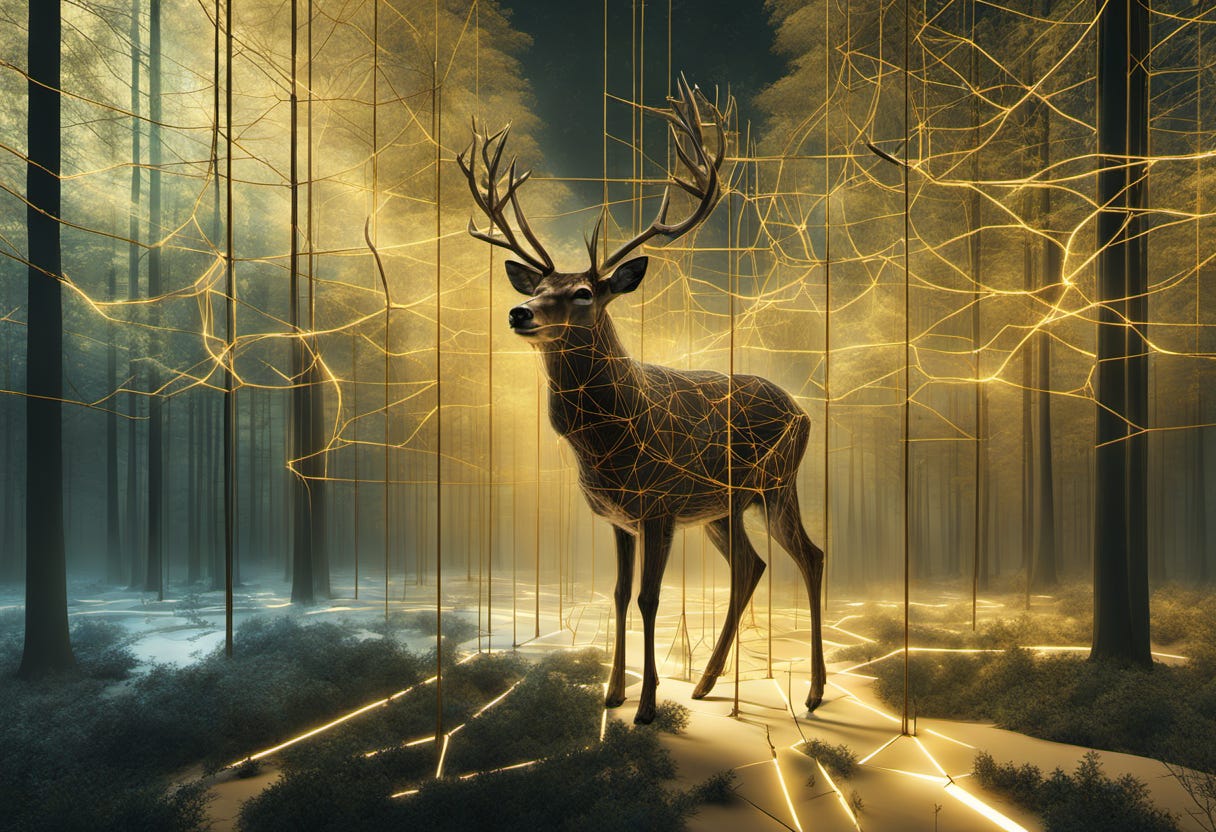
A local simulation is a closed loop—a private experience that hits a wall as soon as complexity grows. To create a true ecosystem, we must move beyond the limitations of a single machine. By distributing the “Global Mind” to the server and the “Local Body” to the client, Līlā breaks the complexity wall. The server doesn’t need to calculate every micro-movement of every blade of grass; it only needs to manage the heavy, slow-moving math of the planet’s health.
More importantly, this architecture allows for a shared reality. In a world where many people inhabit the same forest, sending constant, high-frequency position updates for thousands of entities would overwhelm any network. By sending only intent—the “mood” and “drive” of the creatures—we allow the world to scale. The clients “hallucinate” the movement between pulses, creating a fluid, low-latency experience where the forest feels populated, not just rendered.
We are trading perfect, rigid precision for organic variance. We don’t need the deer to be at an exact coordinate; we need it to feel like a deer that has a reason to be there.
The Grace of Divergence
This is where the true magic of the Līlā architecture lies. In a traditional system, if a client deviates from the server’s path, it is treated as an error—a “de-sync” to be corrected with a jarring snap. But in a living world, divergence is not an error; it is agency.
In Līlā, the relationship between the server and the client is a negotiation. The server sends the intent, but the client has the final word on the execution. It is the difference between a puppet and a pet. You can tell a dog to “fetch,” but you don’t control every muscle twitch in its legs. The dog chooses its own path through the grass, and the “Global Mind” simply acknowledges that new reality.
When the client decides to go its own way, it sends a heartbeat back to the server saying: “I hear your intent, but I am moving this way now—deal with it.” The server then absorbs that deviation, updates the global truth, and continues the simulation from that new point. We don’t punish the entity for being “wrong”; we simply acknowledge its autonomy and move the world forward with it. This is how you achieve a simulation that feels organic rather than mechanical.
In a shared world, this creates a beautiful tension between individual experience and collective reality. While every user’s client might 'hallucinate' slightly different paths or nuances in a creature's movement, they are all anchored to the same global truth. By using deterministic seeds for each entity's personality, we ensure that while the performance of life is local and varied, the pulse of the ecosystem remains shared. We aren't inviting users into each other's private realities; we are inviting them into a single, shared world where every inhabitant has the agency to express its own existence.
Emergence via the Unseen Hand
The magic happens in the gap between these two layers. Līlā fills this gap with the “Unseen Hand”—tiny, specialized neural networks that act as the bridge between Will and Action.
When the Server decides a deer is hungry, it doesn’t send a path. It sends a Latent Vector. This four-dimensional number represents a “mood”: pace, caution, posture, and social orientation. The client receives this vector and translates it into a unique, fluid movement style.
Because the client has local agency, two different observers might see the same deer take slightly different paths to the same water source. In a traditional game, this would be a “sync error.” In Līlā, this is emergence. It is the beauty of a living system where the “Global Mind” sets the boundaries of possibility, but the “Local Body” provides the variance of life.
The Gaia Principle in Code
Līlā is a computational manifestation of the Gaia Hypothesis.
The Gaia Hypothesis suggests that the Earth is a self-regulating organism. A complex feedback loop where the atmosphere, the soil, and the living creatures interact to maintain a state of balance.
Līlā mirrors this perfectly. The Server is the planetary homeostasis (the laws of nature that govern the resources), the Client, the individual life-form (the autonomous agent navigating those laws) and the Intent-Based Protocol which is the connective tissue (the invisible flow of information that allows the planet to “breathe/pulse”)
The Participant as Agent
Finally, we must consider the role of the human. In Līlā, the user is not a passive observer watching a pre-rendered world; they are an active participant in its evolution. When you enter the forest, your presence becomes a new variable in the global math.
Your actions—whether it is clearing a path, introducing a new species, or interacting with the inhabitants—are not just “commands” to the software. They are new injections of intent into the system. When you act, you are feeding the Global Mind new data, which the server then propagates as new drives and states for the local bodies. You are not just playing in a world; you are participating in its metabolism. You are part of the pulse.
The New Paradigm

We are no longer just coding movements; we are coding desires. We are no longer just rendering scenery; we are nurturing an ecosystem. We are building a world where the AI doesn’t talk to you—it lives with you, guided by the unseen hand of a global mind and the participants, expressing itself through the local agency of a thousand tiny, independent lives.
Līlā is not a simulation of a forest; it is a simulation of an ocean. It is a vast, incomprehensible global mind—a Solaris-like sea of intent—where every creature is a single ripple on a surface that is infinitely deep.
This is part of an ongoing project līlā, building a distributed ecosystem simulation.