
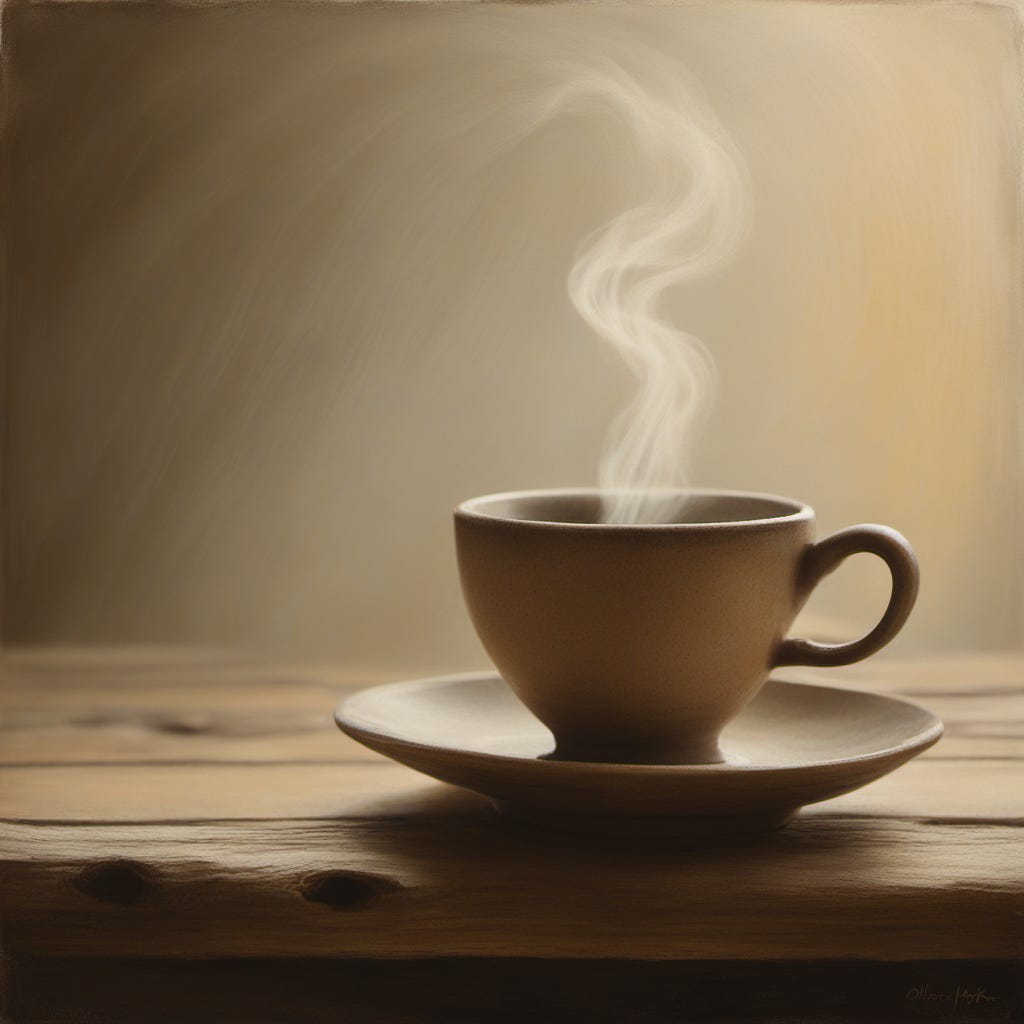
You know that thing steam does when it leaves a cup of coffee? Not the big cloud when you first pour — the quiet part after. The way it curls and thins and finds a shape you couldn’t have drawn, couldn’t have predicted, but you recognize immediately as right. Something about the air in the room, the heat of the liquid, the stillness of your hand. A hundred small physics conspiring into one moment of grace that nobody designed.
That’s the thing I keep chasing. I’m building a world — placing a deer at the edge of a meadow, a butterfly near a cluster of wildflowers, a pond catching light through oak branches — and I realize that the life part, the part that makes it feel real, isn’t any single thing I placed. It’s everything moving between them. The steam, not the cup.
That’s the gap I’ve been thinking about with līlā, the ecosystem simulation engine I’ve been building. Not as a game. Not as a tech demo. As something closer to a new kind of brush.
What a brush actually does
A brush doesn’t paint for you. It translates intention into texture. You load it, you move your hand, and the bristles do something you didn’t individually specify — they splay, they feather, they leave a particular grain. The brush fills in the details below the level of your conscious direction.
That’s what I mean by a motion brush. You describe a world — a few species, some terrain, water, soil — and the engine grows it into something that breathes. Deer graze toward the nearest grass. When the grass is gone, they move to wildflowers. Butterflies find blooming flowers, pollinate them, linger, then drift to the next one. Water levels drop as animals drink. Soil dries. Plants go dormant. And if it rains, the roots remember they’re alive.
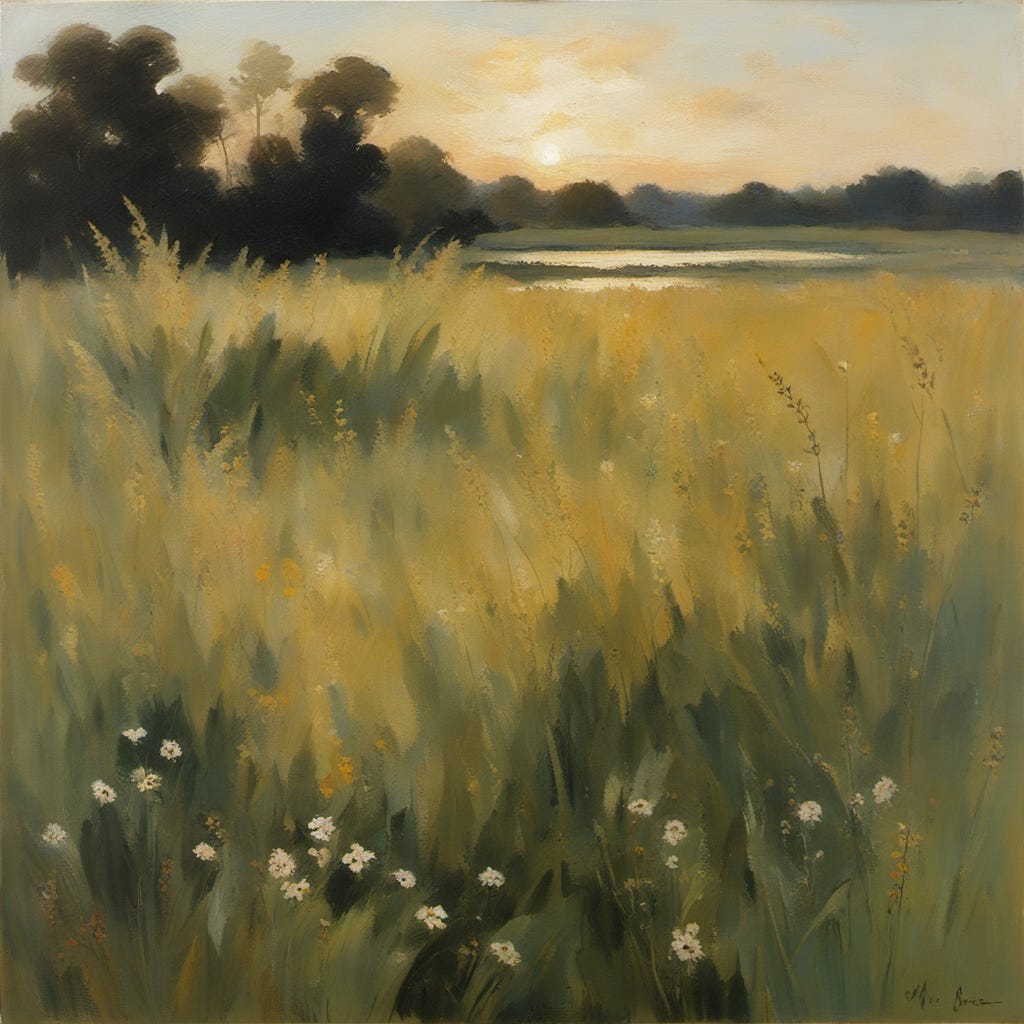
None of this is scripted. None of it is keyframed. You described a meadow, and the meadow started being a meadow.
The AI question
I know. Anything with “AI” in the pitch earns skepticism right now, and honestly it should. Most of what gets sold as AI in creative tools is a replacement engine — feed it a prompt, get back a finished image, a finished song, a finished paragraph. The tool does the creative work. You approve or reject. That’s not a brush. That’s a vending machine.
līlā is trying to do something different. The machine learning inside it is tiny — almost comically small by current standards — and it does one narrow thing: it shapes how a creature moves through space. Not what it looks like. Not what it decides. Just the grain of its motion. The way a deer shifts its weight approaching water. The way a butterfly’s path curves when it senses a flower in bloom.
You never interact with the model. You never prompt it. You probably wouldn’t know it was there if I didn’t tell you. It’s more like the physics of oil paint — the way pigment responds to gravity and surface tension — than like a tool that generates images. The intelligence is in the material, not sitting between you and your work.
What the artist actually controls
Right now, honestly, the creative surface is still rough. līlā is early — an open-source engine in its first alpha. Today you define a world by describing its conditions: what lives here, how the soil behaves, how fast things get hungry or thirsty. It’s closer to writing a recipe than painting a picture.
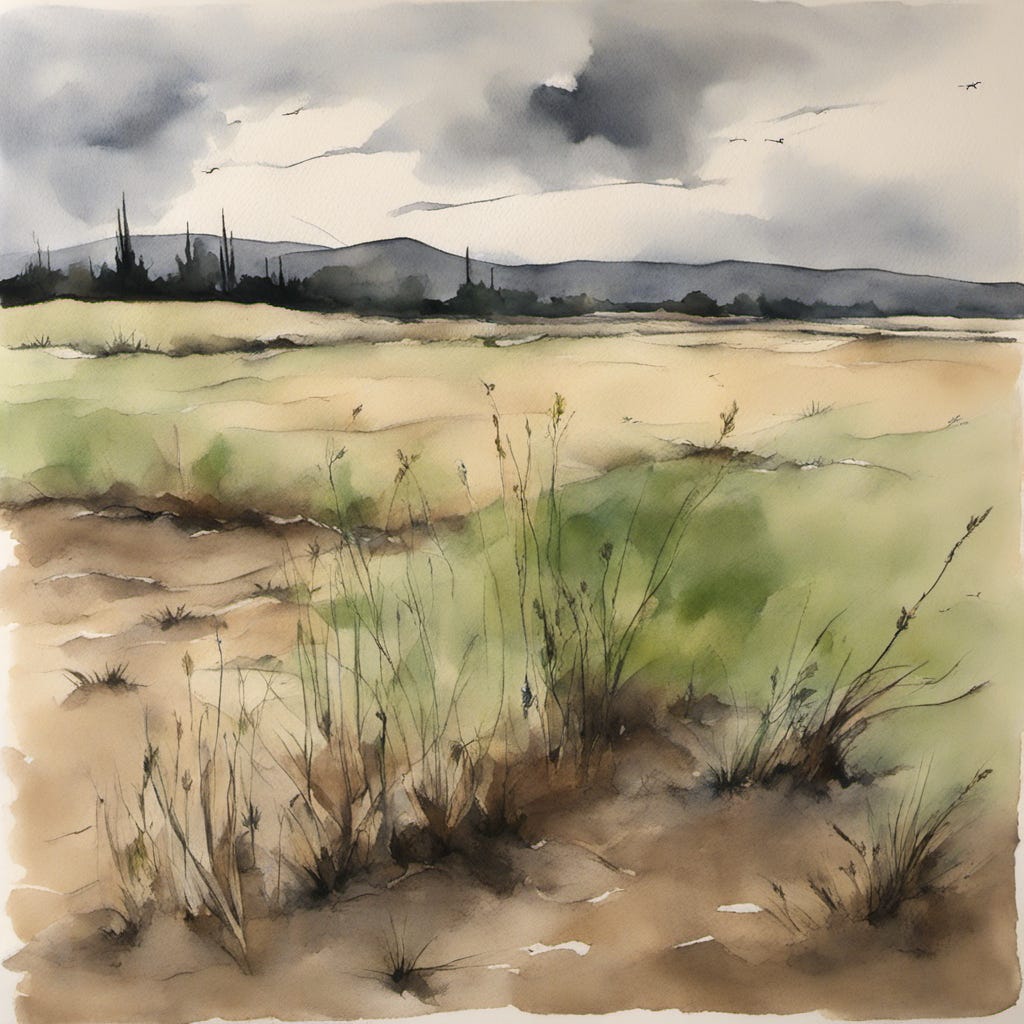
But what comes back is alive in a way that recipes usually aren’t. You can drain the water and watch the cascade — grass dies back, flowers go dormant, butterflies cluster at the last wet spot, deer start starving, and the oaks stand over all of it like monuments to a system that used to work. Then you bring rain and watch it recover. The roots were waiting.
The artistic surface is ecology itself. You’re not composing frames. You’re composing conditions, and the conditions compose the frames for you. Every run feels different, the way every brushstroke from the same loaded brush feels different. The vision — and it’s a vision, not a finished product — is a tool where you shape a living world as intuitively as you’d shape clay. We’re not there yet. But the engine underneath already knows how meadows work.
Where this is going
Right now līlā renders in a browser — a flat canvas with little triangles for deer and flapping dots for butterflies. It’s honest and it’s ugly.
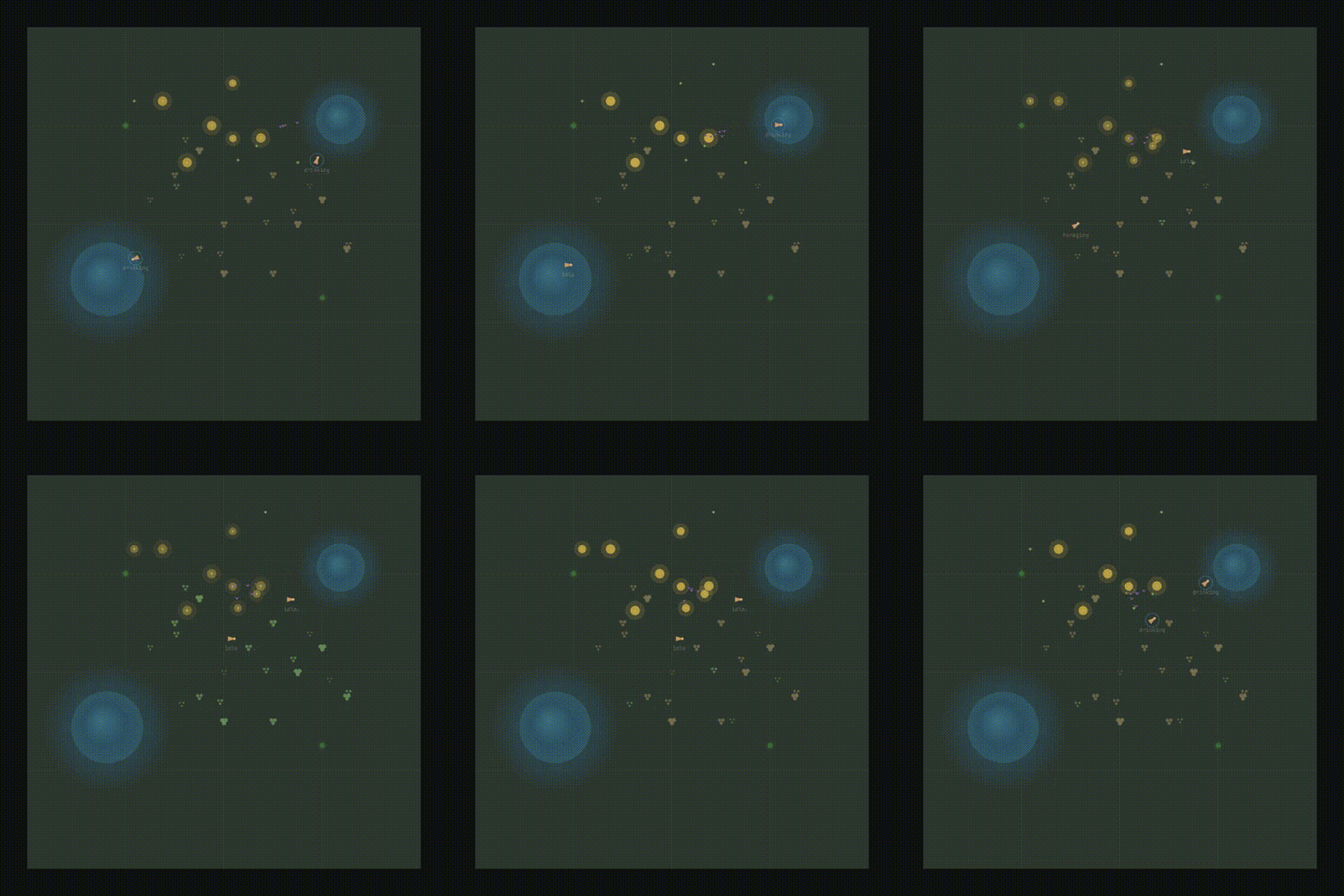
The next step is a 3D client where the motion model actually drives skeletal animation. That’s the real demo: a deer whose gait emerges from reading the state of the world around it. Not motion capture. Not canned animation loops. A creature whose movement belongs to the moment it’s in, running ten times a second, invisibly, while you watch something that just looks like a deer walking to a pond.
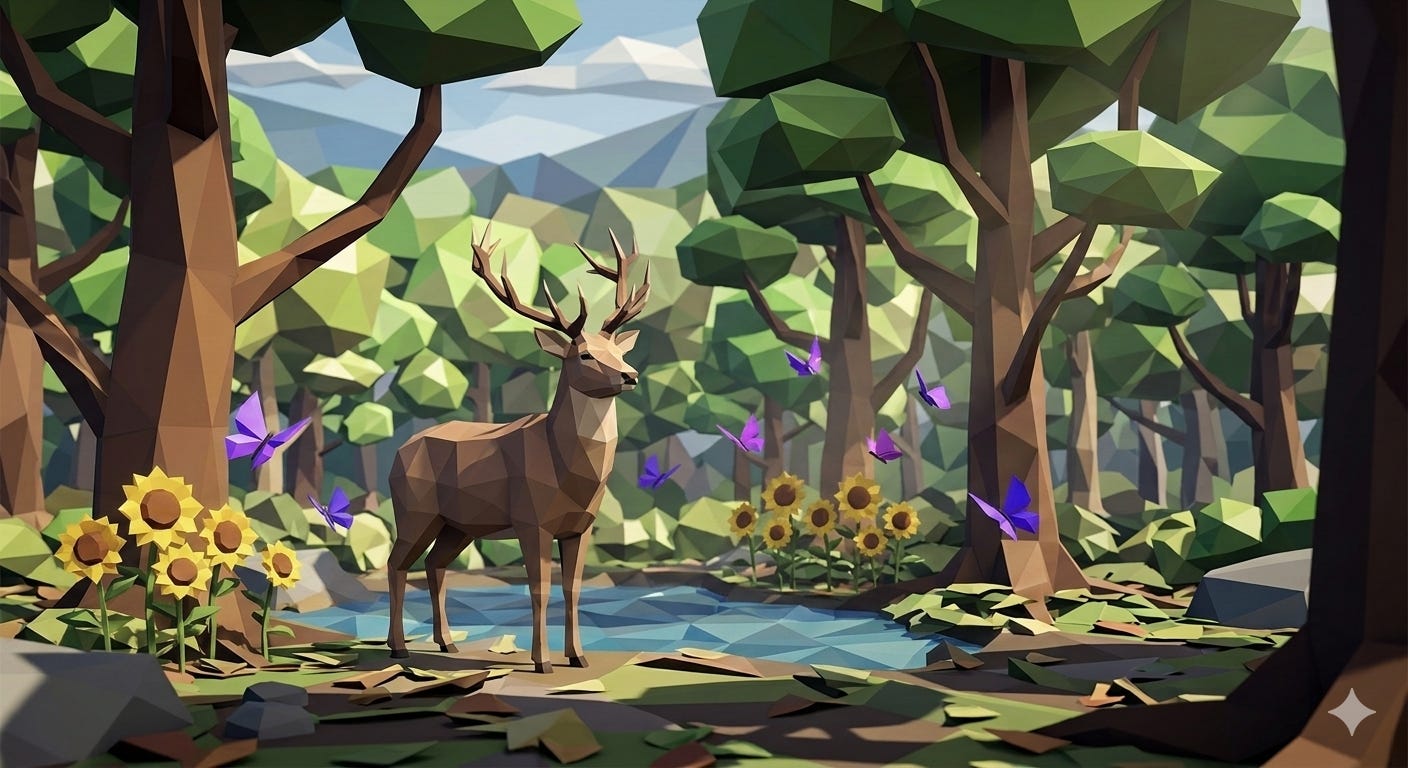
That’s the brush I want to build. One where the medium understands motion the way oil paint understands gravity — not because someone programmed each drip, but because the physics are in the material.
Why I think this matters
Every generation of creative tools has expanded what a single person can make. Photoshop gave painters layers. DAWs gave musicians infinite tracks. Game engines gave storytellers real-time worlds.
But the life inside those worlds has always been hand-animated or scripted. Every footstep, every wing beat, every grazing motion — someone had to make that, or buy it from an asset store, or settle for a loop that feels like a loop.
What if the motion was part of the medium? What if you described an ecosystem and it moved like one — not because you choreographed it, but because the brush understood what meadows do?
That’s what I’m building toward. A world that plays as itself.
līlā is open source under Apache 2.0. The name comes from the Sanskrit word that means spontaneous creative play — reality unfolding for no reason other than the joy of unfolding. You can find it at github.com/hellolifeforms/lila, and follow along at @hellolifeforms on Bluesky.