

Līlā is not a project about animation. It is an exploration of what it feels like to stand beside an intelligence that does not speak — and to feel, instead of unease, a sense of curiosity. It is the feeling of a deer lifting its head when you enter a clearing. The creature is clearly aware, but it will never explain itself in words because it has none.
The question Līlā asks is whether we can build a non-verbal other that a person feels safe beside — a thing that is genuinely present rather than a costume worn by a script. In The Pulse of Līlā, I described this as a global mind issuing pulses of intent to local bodies. This essay provides the mathematical foundation for that feeling. To lay it, I must start with the oldest problem in AI: how do we encounter a mind that won’t meet ours?
I. The Mirror We Came For
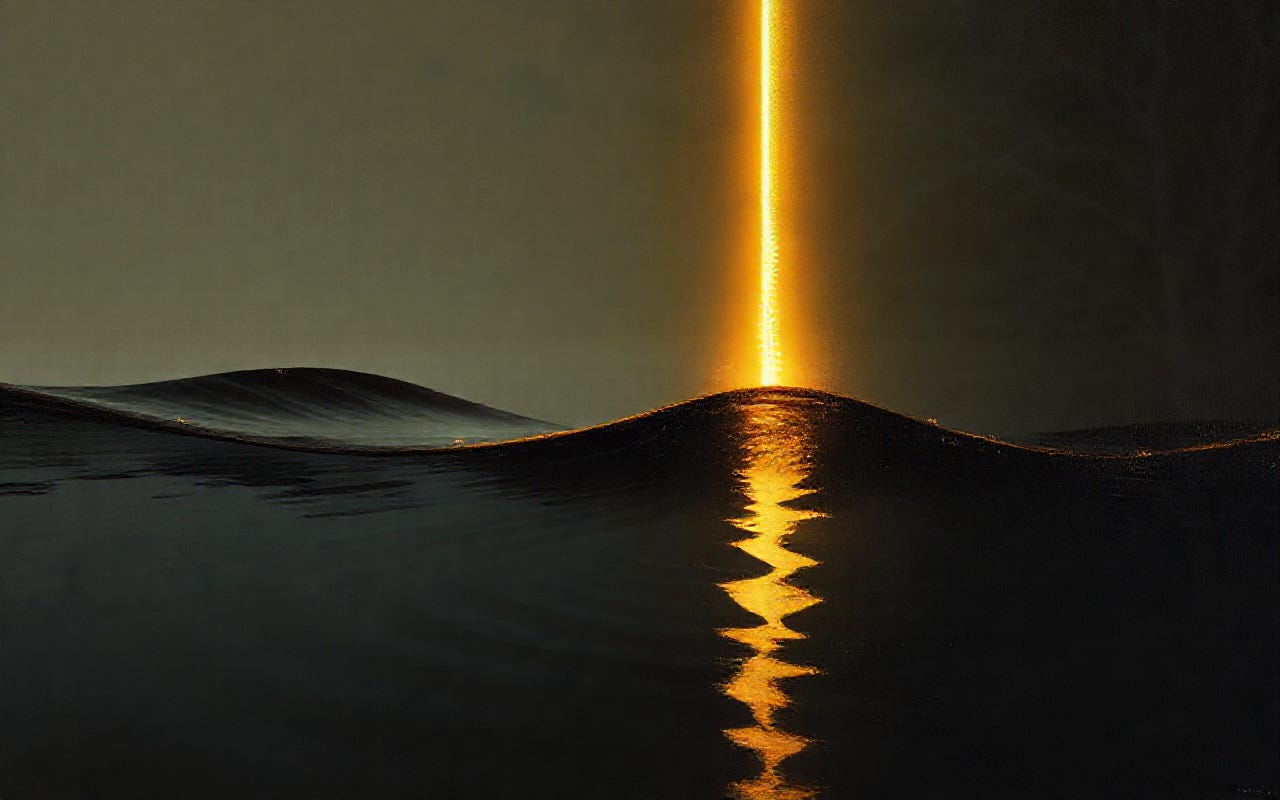
The definitive story of meeting a mind that will not meet you back is Lem’s Solaris: a planet-spanning ocean that is, by every test, a single intelligence, yet it remains fundamentally misunderstood. Contact never comes because the researchers demand that the ocean resolve into their own terms — that it turn out to be a mind shaped like theirs. We went looking for mirrors. When the ocean finally answers, it reflects the askers back at themselves.
That is the far pole of non-verbal intelligence: a mind so alien that the attempt to relate collapses into dread. Līlā lives closer in. We are building for humans, and a thing a person can love or be curious about must be relatable. It doesn’t need to be transparent; it needs to be approachable.
The right register is not the ocean; it is the animal. You have stood beside non-verbal intelligences your whole life: a dog deciding whether to trust you, a cat tracking something past the window. None of them explain themselves, yet the relationship is real. It is legible enough to be safe and opaque enough to stay interesting. That narrow band — relatable but not knowable — is our emotional target.
II. The Contradiction
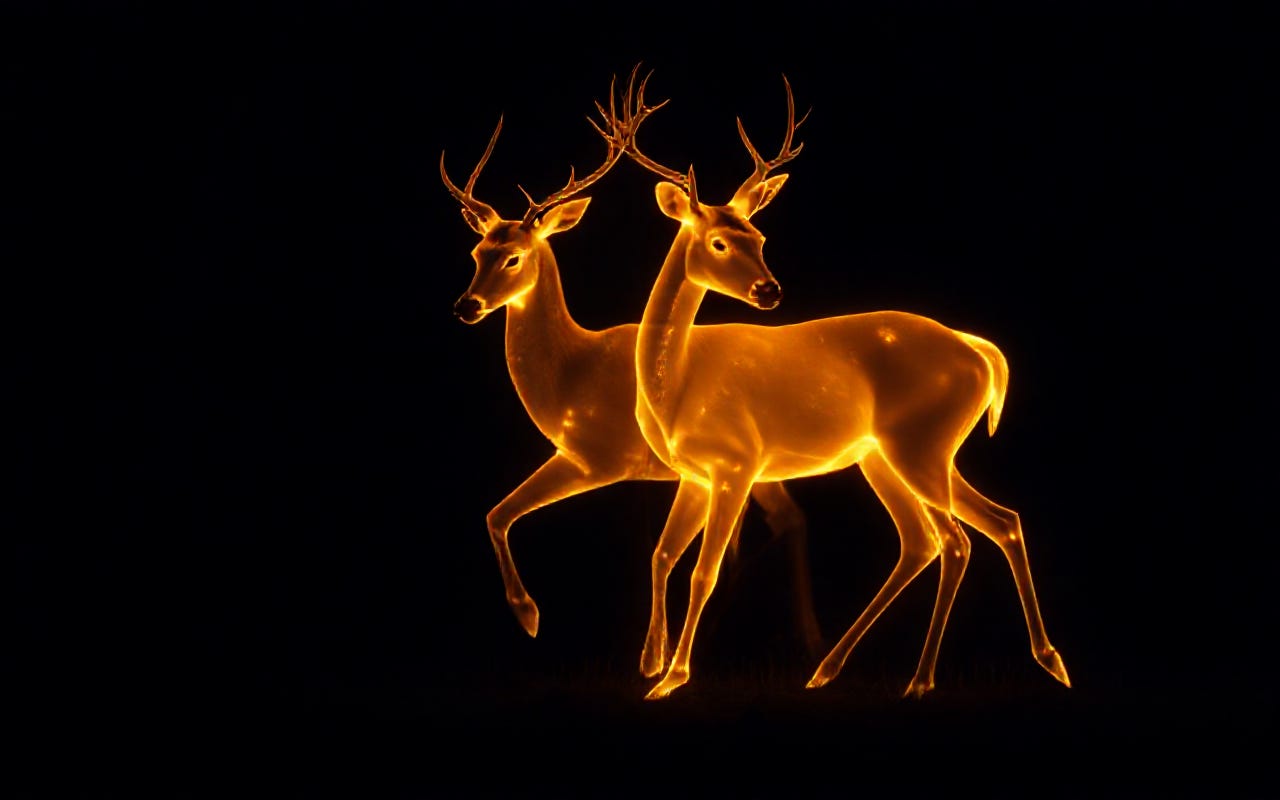
This philosophy creates an engineering problem: how can two people watch the same deer take different paths and still inhabit the same world? If the deer is in two places, are there two deer?
Conventional simulation says we must force agreement — broadcast one canonical position to every screen. But forcing agreement costs the creature its life. A creature whose every turn of the head is identical on every monitor is not “other”; it is a puppet with excellent rigging. Exact coherence is just the mirror in technical dress.
To build a non-verbal other, the creature must exceed any single perspective. That excess, rendered onto two screens, means two people see it slightly differently. This forces a deeper question: if not the exact state, what do two observers share? They share the invariant: the event the accounts are of. Observers in motion disagree about lengths and durations, but they share the geometry beneath the coordinates. Disagreement about appearance is the signature of one deeper reality, not a threat to it.
A shared world is not a state everyone copies; it is the fixed point of every perspective turned toward it. For a non-verbal mind, the part that won’t reduce to any one view — the interior you cannot enter — is the reason it is worth meeting.
III. An Intent Is a Vector Field, Not a Path
A path is a record: a function that says “here, then here.” It carries no reason and cannot respond to a rock in the way. A vector field is a law: a function that tells you which way the system tends from any given state. A path is simply one solution to that law.
In Līlā, I define intent as a parameterization of the local vector field. When the Global Mind “sends intent,” it is not transmitting a trajectory. It is transmitting the coefficients of a differential equation. The client does not decompress a path; it integrates a law it has been handed.
Here y is the full state of the body — joint angles, velocities, root position — and z is the latent intent vector: pace, caution, posture, social orientation. The weights θ are the learned constants of the Unseen Hand, baked into the client. Only z travels across the wire.
The deer responds to the rock because it is solving a law, not replaying a recording — its agency is real. The motion remains fluid between pulses because integration is continuous. And the network cost collapses: a law is small, but the behavior it generates is large.
IV. Three Clocks: The Architecture as a Separation of Timescales
The precise version of this world is a three-timescale dynamical system. This separation of scales is what makes the project computable.
The slow clock — the planet. The global state S (nutrient density, population fields, water) evolves over minutes to hours. I model these as reaction–diffusion on the world surface. This is spatial field math — it scales with the size of the world, not the number of creatures.
The middle clock — intent. Every second or so, the server samples a latent vector from the local state of the planet. "Thirst" is not a toggle; it is an internal reservoir ξ crossing a threshold, multiplied by the gradient of the water field that tells the body which way water lies.
The fast clock — the body. At 60 Hz, the client integrates the body law. To the fast system, the intent vector z is effectively constant — the planet does not change in the 16 milliseconds between frames. This is singular perturbation: the fast variables see the slow ones as frozen, and the slow ones see only the time-averaged behavior of the fast. The deer's legs and the soil's chemistry are formally decoupled by the ratio of timescales. That decoupling is the mathematical permission slip for putting one on the server and one on the client.
V. Why a Gait Is a Limit Cycle
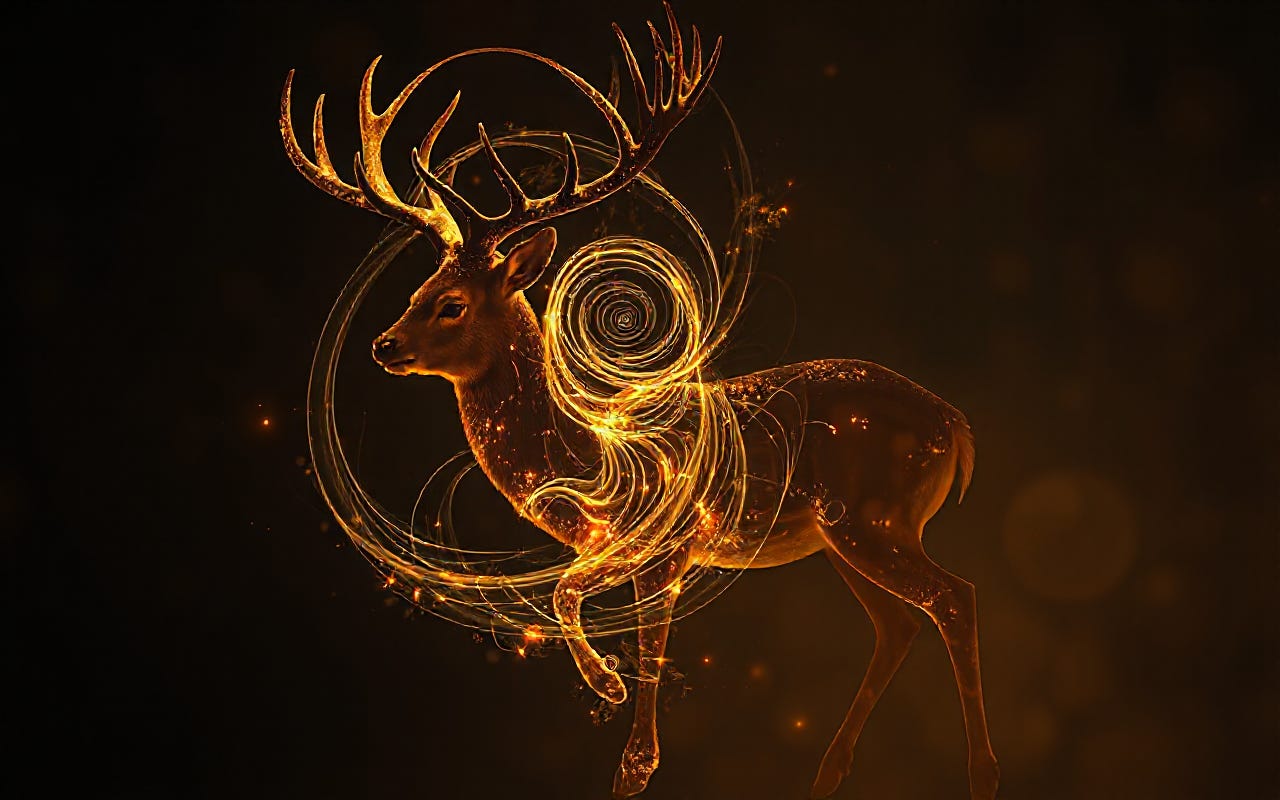
A walk is not a curve; it is a stable oscillation — a closed loop in the space of joint angles that the body returns to after every disturbance. In dynamical systems, a gait is a limit cycle: a periodic orbit that attracts. If you push the deer, it stumbles, then falls back into its rhythm.
The model for the body is therefore a bank of coupled nonlinear oscillators. The cleanest choice is the Hopf oscillator, one per joint or limb.
Each constant is a vocabulary of style. The amplitude parameter μ sets how big the stride is. The recovery strength a determines how quickly the creature returns to rhythm — high for a raccoon snapping back instantly, low for a deer swaying loosely. Intrinsic frequency ω sets the pace. Phase offsets ψ between limbs define the gait itself: walk, trot, and gallop are not different animations; they are different solutions of the same oscillator bank. The equilibrium point q⁰ is posture.
“Style” was never a texture sprinkled on motion. Style is the parameter set of the body’s oscillator law. Raccoon-ness and deer-ness are simply different regions in a finite-dimensional space of dynamics.
VI. The Unseen Hand: A Learned Map
While the oscillators provide the physics of the body, they still require a driver—a way to map high-level desire onto these low-level dynamics. The intent is small — four numbers, a mood. The oscillator law has many parameters. The Unseen Hand is the learned function that closes the gap: it expands a four-dimensional mood into the full coefficient set of a dynamical system.
I do not hand-author these constants; I recover them from footage. The pipeline is system identification of limit cycles: pose-estimate video into joint-angle time series, extract phase and amplitude via the Hilbert transform, then pull the parameters directly. The learned map h_θ is then fit so that integrating the resulting oscillator law reproduces the observed motion.
VII. The Grace of Divergence, Made Exact
In The Pulse of Līlā, I argued that an authoritative server is a fallacy — a server commanding coordinates kills the agency that makes a creature feel alive. That remains true. In this architecture, the body remains local, emergent, and governed by its own internal law.
However, a shared world introduces a requirement a single mind never faced: consensus on causal facts. In a multi-user environment, pure emergence leads to solipsism — if User A’s deer is at the water’s edge and User B’s is three meters upstream, they are no longer inhabiting the same world. The fallacy was never authority itself. It was authority applied to the wrong layer.
The solution is not to move from “distributed” to “authoritative,” but to split the truth into two distinct layers:
The consensus base c holds the coarse, slow, causally loaded facts: location on the landscape grid, metabolic state, and life status. This must agree across all clients because it determines what happens next in the world.
The cosmetic fiber e holds the fast performance: gait phase, sub-meter positional offsets, and head tilt. This is local to each client and free to roam. It is the creature’s irreducible interior — the part of the deer that belongs to no one’s screen.
Two users at one spring occupy the same point in c (the deer is here, drinking) but different points in e (one sees the head lowered; the other sees it mid-stride). They are not in two worlds; they are at one place in the base of a fiber bundle, riding two sections of its fiber.
This architecture is governed by two constraints:
The Kernel Condition. The fiber may roam only so long as nothing in it moves the base. The planet’s slow math must see c alone.
We quantize consensus events so that the fiber cannot leak into them. “The deer ate the grass at grid cell (4, 7)” is a base fact. Which blade, at which angle, is fiber.
The Collapse Condition. The acceptable divergence shrinks to zero the instant the fiber is observed at fine grain or acted upon. To touch the creature is to force it, for an instant, to be fully legible. The interaction must resolve against a single consensus value, and the fiber collapses locally onto that value.
We have not traded distribution for authority. We have partitioned the truth. The mind stays distributed in the fiber — the aesthetic performance of life. The world is anchored in the base. Emergence still runs the creature; it simply has a common ground to inhabit.
VIII. Finding the Way Back
Two kinds of divergence live in this system, requiring different resolutions.
Predictive divergence is plumbing. The server maintains a coarse estimate while the client integrates high-frequency motion. They drift; the client sends a heartbeat; the server re-anchors. Because the correction lands on the slow component, there is no visible snap.
Observational divergence is the material of the world. The Hopf oscillator contracts in amplitude but is neutrally stable in phase — nothing pulls two phases together unless they share an identical seed. Two clients running the same limit cycle at different phases produce the signature of a shared reality: one deer mid-stride, one head-down, both unmistakably living the same gait.
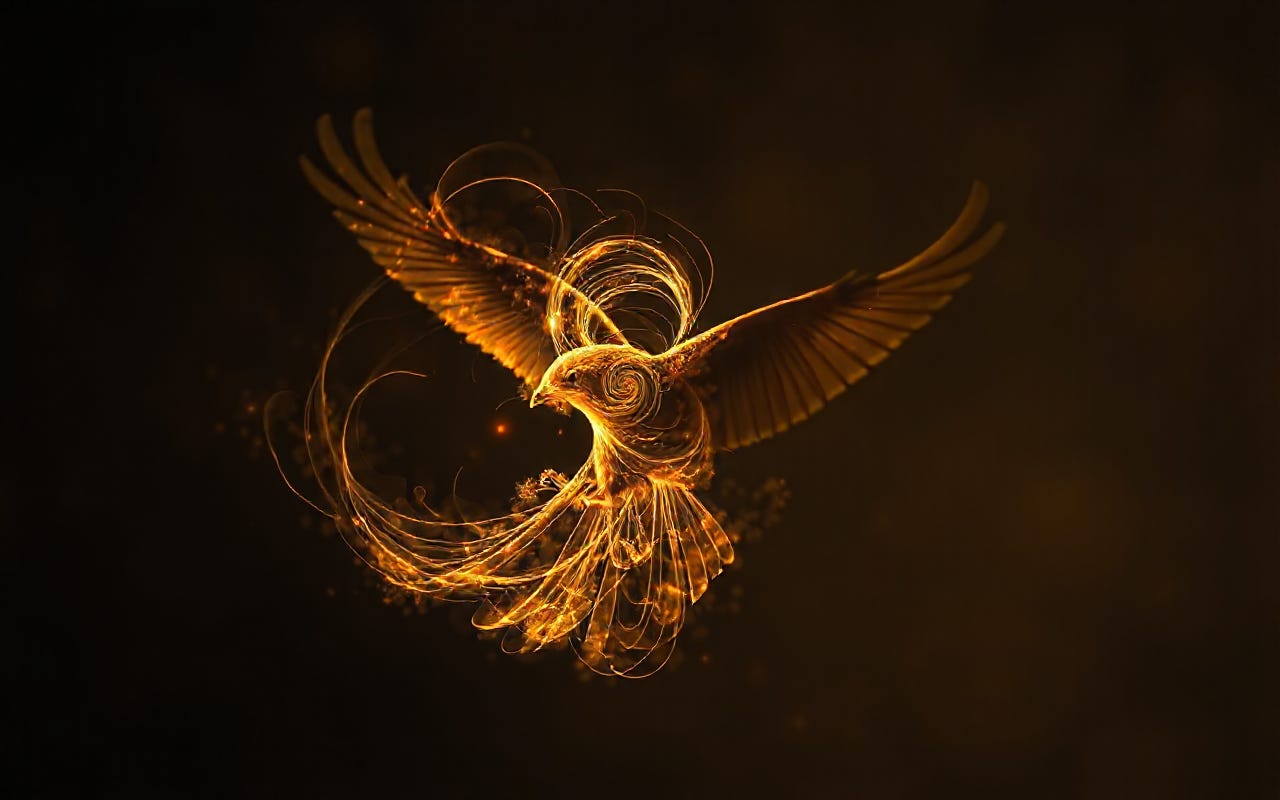
When drift exceeds the cosmetic band, we do not snap the creature. Reconciliation is issued as an intent. The server never edits the bird’s coordinates directly. When divergence crosses a threshold, the server issues a homing intent — a goal set aimed at the authoritative position — and the bird flies back under its own flight dynamics, its own limit cycle, and its own style. The correction channel and the behavior channel are the same channel.
A graded gain ensures this feels like a decision rather than a correction. At small divergence, the gain is near zero — the creature wanders freely. As the gap grows, the gain rises, and the homing intent inflects the trajectory. The creature does not teleport; it simply becomes more interested in going somewhere.
Now the harder case: what if the divergence is not cosmetic, but lethal?
Suppose a predator enters the scene. On one screen the deer is ten feet from the strike zone; on another, twenty. If that distance determines survival, the fiber has leaked into a causal fact — exactly what the Kernel Condition forbids. The answer is that survival is a base fact, not a fiber fact, and was never free to diverge in the first place.
The server does not track continuous distance to the predator. It tracks discrete states: Roaming, Alert, Fleeing, Consumed. These are base variables. When the server determines that the deer has entered the predator’s engagement radius — computed from the consensus position c, not any client’s local e — it issues a state-change pulse. The transition from Roaming to Consumed is global. Every client receives the same event.
What differs is the performance of that event. On one screen the deer stumbles left; on another, right. The rhythm of the oscillators breaks — amplitude drops, the limit cycle loses its hold, the body’s law plays out its own collapse. The fact is shared. The experience of the fact is private. Two people watching the same animal die will describe it differently, because they always do.
Because the fiber is free to roam within the margin of the moment, the system produces near-misses — a deer that was almost close enough, a predator that almost struck. The server resolves these encounters from the base, and the base alone. The exact coordinates of the fiber, irrelevant to the outcome, create the felt contingency of the scene. The gap between the fiber and the base is where luck lives.
IX. Chance
In a world with one observer, there is no luck. The law runs, the state evolves, and the event arrives exactly where the integration said it would.
Add a second observer, and something shifts. Each client integrates the same law from a slightly different fiber — different phase, different sub-meter offset, a different version of the moment. Each one, running its local trajectory forward, would predict a slightly different outcome. But the event does not resolve from either prediction. It resolves from the base. The server evaluates the consensus position, applies the causal threshold, and issues the state change. The result is authoritative, and it does not perfectly match what either screen was showing.
This is where the impossible escape comes from. On your screen, the predator was right there — the strike looked certain. On mine, the deer had more room than you thought. The base, computing from the consensus, found the deer outside the engagement radius. The deer lives. From your view, that survival is inexplicable. You saw the gap close. You saw the moment arrive. And then the moment passed, and the deer walked away, and you cannot account for it from your screen alone — because the outcome was never settled from your screen alone.
The impossible win works the same way in reverse. A creature that looked safe on one client is suddenly consumed, because the consensus position — invisible to any single observer — crossed a threshold that no individual fiber predicted. From one angle it looked like carelessness. From another it looked like bad luck. From the base it was simply arithmetic.
The effect scales with the number of observers. One viewer sees determinism. Two viewers see occasional surprise. A hundred viewers inhabit a world where outcomes routinely exceed any single prediction, where events feel authored by something larger than any participant’s understanding.
This is not a simulation of chance. It is a production of chance — the same way the physical world produces it. We never experience randomness as static. We experience it as the world not matching our local model. A hunter watches the shot miss by an inch and calls it luck. A bystander, standing ten degrees to the left, saw a comfortable margin. The fact of the miss belongs to neither account. It belongs to the encounter itself — the geometry of the event as it existed across all perspectives on it.
Līlā does not need to fake this. The architecture, built to solve a synchronization problem, produces felt chance as a structural byproduct of shared observation. Luck is not something we add. It is something we cannot prevent, the moment more than one mind is watching.
X. The Bandwidth Argument, Paid in Full
The Pulse essay claimed that sending intent scales where sending coordinates does not. Now we can count the difference. Coordinate streaming requires sending the full body state at frame rate: roughly fifty degrees of freedom at sixty frames per second. Intent streaming costs four floats at perhaps two hertz. The ratio is nearly three orders of magnitude.
The client is not receiving a compressed signal; it is holding the decoder. The weights θ — the entire learned dynamics — already live on the client. The server ships only the latent code z, and the client generates the full-rate motion from it. This is rate-distortion logic: when both ends share the generative model, you do not transmit the signal; you transmit the latent that conditions it.
XI. The Pulse, Restated
Return to the ocean. Every creature a ripple on a surface infinitely deep.
The deep surface is the slow manifold: the planet’s resource fields, drifting under reaction and diffusion. The ripples are limit cycles: each body an oscillator that forgets where it began and remembers only its rhythm. The flow between them is the intent map: a low-dimensional mood, sampled from the gradients of the deep, expanded by the Unseen Hand into the law a body lives by. And the reason all of us stand on the same shore watching the same sea is contraction on the base — the guarantee that what is happening is single, however freely each surface performs it.

Gaia was the right metaphor. I would only sharpen it: the planet is not one homeostatic loop but a hierarchy of coupled dynamical systems, separated by their clocks, married by their gradients. The pulse is the slow manifold breathing. Life is the fast oscillation riding on top of it, varied in its surface and identical in its law.
We are building a world where the facts are shared and the experience of those facts remains private. The deer came; the deer drank; the deer fled or did not flee. That is the base, and everyone agrees. The angle of the light, the instant of the glance, the three-foot difference between your screen and mine — that is the fiber, and it belongs to no one but the creature. The divergence is not a flaw in the synchronization. It is the deer having an inside. And because the facts are settled across observers rather than within any one of them, the world surprises even the people who built it. The creature feels alive and the world feels contingent for the same reason: neither belongs entirely to you.
We were never coding movements, and never quite coding desires. We were choosing where, in the space of all possible dynamics, each creature should live — and then trusting the law, and the gap it leaves, to make something you could meet.
Part of The Geometry Beneath. The project lives at github.com/hellolifeforms/lila.