
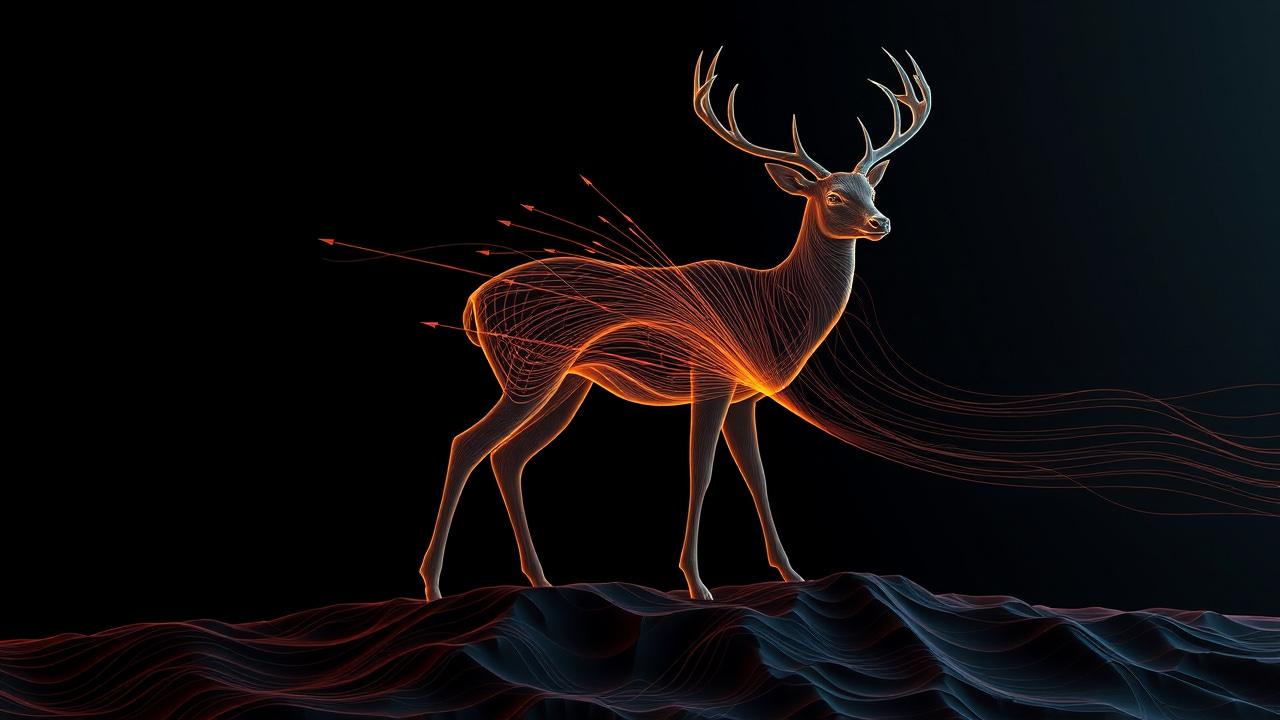
In The Mathematics of Līlā, I argued that the “body” is a local integration of a law. I described the gait as a limit cycle — a stable oscillation of joint angles that the creature returns to after every disturbance. I showed how a fiber bundle partitions the shared world into consensus facts and private performance, and how reconciliation itself is issued as intent, so that the correction channel and the behavior channel are the same channel.
But a limit cycle in a vacuum is a ghost. It has no weight, no friction, and no consequence. The oscillator banks of Mathematics produce motion, but they produce it in free space — as if the deer were walking on glass.
To move from the mathematical possibility of a creature to the felt presence of an animal, we must introduce the most fundamental constraint of reality: Resistance.
If the Mathematics of Līlā is about the will of the creature, the Physics of Līlā is about the will of the world. It is the study of how the vector field of intent meets the manifold of matter.
I. The Agency of Friction
In a kinematic simulation, an entity moves because its position is updated. In a physics-based simulation, an entity moves because it is pushed.
This is the shift. We are moving the client-side body from a position integrator to a force generator. When the client receives an intent vector z — the mood, the pace, the posture — it no longer updates the creature’s coordinates. It uses that vector to calculate the forces necessary to achieve the intended state, and then it applies those forces to a body that has mass, that has inertia, and that is standing on ground that pushes back.
The creature becomes a dynamical system solving for equilibrium against a world that resists. Its motion is governed by a single equation:
Read left to right, this is a negotiation. On the left, m is the creature’s mass and the double-dot is its acceleration — the two together are what actually happens. On the right, four forces fight over the outcome:
F_drive is the creature’s will made physical — the force the Body generates from its current state y and intent vector z. This is the “push.”
c(x, τ) · ẋ is the world’s reply — a drag force that opposes velocity. The coefficient c depends on both the local terrain at position x and the species trait vector τ (more on this in Section II). Wet ground means high c; the creature must push harder for the same speed.
mg∇h(x) is gravity’s claim on every slope — the gradient of the terrain height h at position x, scaled by mass and gravitational acceleration. Where the ground rises, this term pulls the creature back downhill.
k(x_s − x) is the restoring spring described in Mathematics — a gentle pull toward the server’s consensus position x_s that grows with distance, hiding synchronization inside the feeling of weight.
If a deer wants to move North but is standing in deep mud, the Intent remains North. The Planner recognizes the mud. The Body generates the force. The physics engine calculates the resulting acceleration, which is severely dampened by the mud’s high c.
In a kinematic world, the animal glides over mud. In a physics world, the animal struggles through it. And struggle is not a failure of the system. The struggle is where the non-verbal other finds its weight.
II. Every Body Reads a Different World
In Mathematics, I described the voxel grid as the substrate of the planet — a field of nutrient density, moisture, and chemistry evolving under the Slow Clock. That grid served the server: it was the medium for the reaction–diffusion math of the ecosystem.
In Physics, the same grid serves the body. The client reads the local voxels not as chemistry but as terrain — as a cost map of traversability. But the cost map is not universal. It is species-relative. The same world, read by different bodies, produces different landscapes of effort.
The resistance coefficient c that appeared in Equation 1 is not a constant. It is a function of two things — the local state of the world, and the traits of the creature moving through it:
S(x) is the raw state of the world at position x — everything the voxel presents at that point. τ (tau) is the species trait vector: the body’s set of sensitivities and tolerances — how it handles slope, how it responds to soft ground, how much the wind moves it. The function ϕ is the reading — the act of a particular body interpreting the raw world as resistance. The same voxel, passed through different trait vectors, yields a different cost.
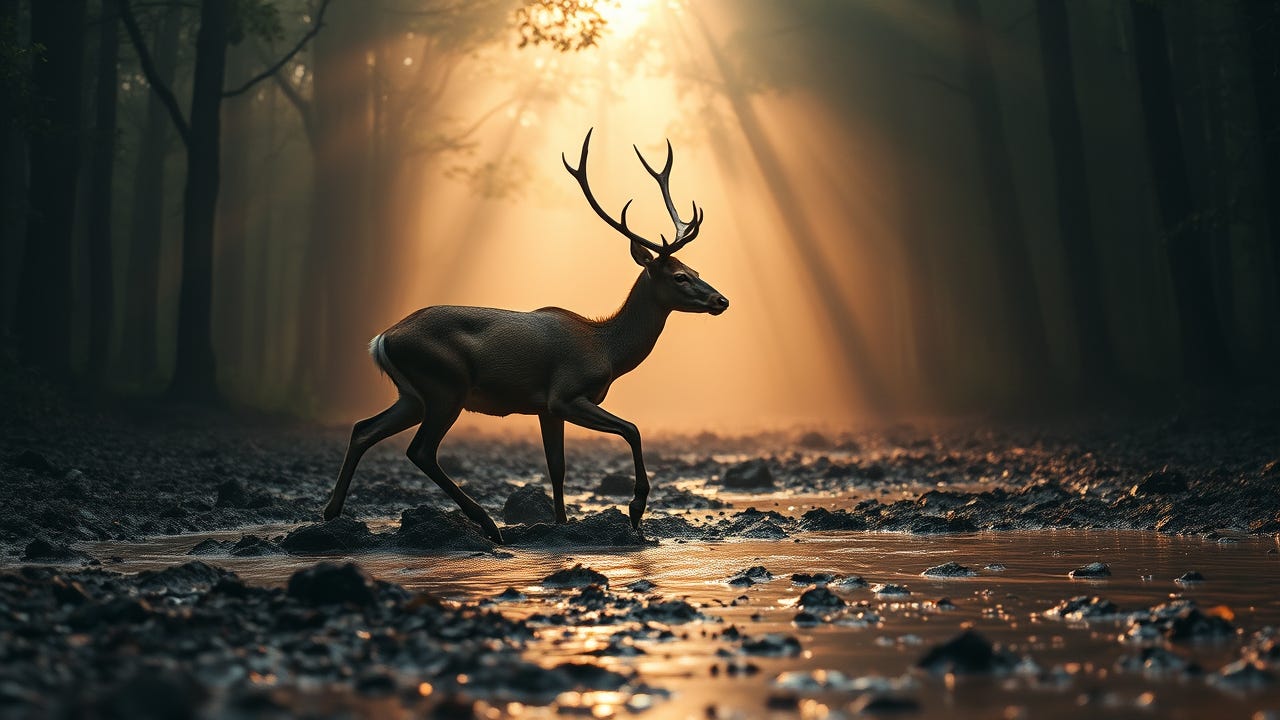
A deer reads a saturated voxel as drag. Its hooves sink; the mud pulls against every stride. A mountain goat reads a steep gradient as nearly flat — its trait vector carries a slope tolerance that makes a forty-degree incline register as moderate effort. The same rock face that walls off the deer is a corridor for the goat.
A bird does not read the ground at all. Its S(x) is the wind field and the thermal map. A column of rising air is not “convection” to a bird — it is a place where altitude is free, where the body gains height without drawing from its energy reservoir. The drag term in the equation of motion becomes air resistance, low and steady, and the dominant cost is not friction but the sustained force required to maintain altitude in still air. A bird circling in a thermal is not idling. It is refueling.
A butterfly is the extreme case. Its mass is so small that its own drive force is dwarfed by the wind. The erratic path of a butterfly in flight is not inefficiency — it is what the path of least resistance looks like when the world’s forces overwhelm the creature’s own. The butterfly is the animal most governed by the manifold and least governed by its intent. It moves the way a leaf moves, but with just enough will to steer.

The Planner uses this cost map to generate direction. Given a goal — the water source, the patch of shade — it computes a distance transform D(x) across the cost field: the total accumulated cost of traveling from every point to that goal. The result is a landscape of effort — a topography where “downhill” means “cheaper.” The creature follows the direction of steepest descent on that landscape:
D(x) is the distance transform — the total traversal cost from position x to the goal. Its gradient ∇D points uphill, toward increasing cost. The negative gradient −∇D points downhill, toward the goal along the cheapest path. The denominator normalizes it to a unit vector — the Planner provides only direction. The Body decides how hard to push.
The creature does not need to see the goal or plan a route. It only needs to read the local slope of the cost landscape and step in the direction it falls. This is what gives the creature its uncanny competence. The deer appears to “think” about the terrain because it is solving the geometry of the terrain. But it is not deliberating. It is doing what water does: flowing downhill on a surface shaped by its own body’s relationship to the world. The intelligence is in the field, not in the creature’s head.
The distance transform is the simplest version of this Planner — a classical algorithm, fully legible. But the architecture is modular. The same slot could hold a learned navigation model, trained on footage of real animals reading real terrain, the way the Unseen Hand is trained on footage of real animals moving. In robotics, this is already happening: vision-language navigation models like Qwen-RobotNav are collapsing the Planner and the World Model into a single learned function that reads a visual scene and outputs a trajectory. The hierarchy does not care what the Planner is made of. It cares only that the Planner reads the cost map and produces a direction. A simple species may navigate by gradient descent on a distance field. A complex species may navigate by a learned model that has internalized the cost map through experience. The trait vector τ becomes not just a set of physical tolerances but a choice of navigation strategy — and the rest of the architecture remains unchanged.
In Mathematics, I said that “raccoon-ness” and “deer-ness” are different regions in the parameter space of the oscillator — that style is the coefficient set of the body’s law. Here the same principle extends to the world. The oscillator parameters define how the creature moves. The trait vector τ defines how the creature reads the world it moves through. Together, they determine what it is like to be that body in that place.
The voxel grid, which began in Pulse as a planetary metabolism, has become — without any new data, without any additional transmission — the creature’s sixth sense. The world the server breathes is the same world the body navigates. The Slow Clock and the Fast Clock are reading the same page. They are simply reading it with different eyes.
III. The Price of Every Newton
Resistance is not free. Every force applied by the Body to overcome the World must be paid for.
In Mathematics, I introduced the internal reservoir ξ (xi) — the variable that crosses a threshold to produce thirst. In Physics, ξ becomes something more consequential: a budget. Every newton of force the creature generates draws from ξ:
The first line is the drain. ξ̇ is how fast the reservoir is changing. It drops at a rate proportional to how hard the body is pushing — α (alpha) is the metabolic cost per unit of force. It refills at rate γ(x) (gamma), which is determined by the voxel grid: where the world offers food or water, energy trickles back in. The second line is the cap. The body cannot produce more force than the reservoir can support — F_max is a ceiling that falls as ξ falls. These two lines form a closed loop: spending force costs energy; low energy caps force.
Moving through mud requires higher force — ξ drains faster. Moving uphill requires a constant force against gravity — ξ drains steadily. A trot is faster than a walk, but its limit cycle demands more power to maintain stability — the gait itself has a metabolic price. And a sprint, which abandons the efficient oscillation of the trot for a burst of maximal output, is ruinously expensive.
This is where the three essays converge. Pulse established the Slow Clock: the planetary chemistry that governs where resources exist. Mathematics established the Fast Clock: the oscillator that governs how the body moves. Physics closes the loop between them. The Slow Clock determines whether the grass at grid cell (4, 7) has been eaten. That determines whether ξ refills. And ξ determines what the Fast Clock can afford.
A starving deer cannot sprint. Not because a rule says “if hunger > 0.8, disable sprint.” Because the force required to sustain the sprint’s limit cycle exceeds the energy the reservoir can supply. The intent is physically capped by the biology. The creature’s body fails it the way a real body fails — not by refusing, but by not having enough.
When you watch a creature in līlā slow from a trot to a heavy walk on a long hill, you are watching a multi-scale negotiation. The high-frequency physics of friction and momentum, governed by a mid-frequency intent, governed in turn by the low-frequency chemistry of the planet. The behavior you see — the faltering gait, the slowing pace, the lowered head — is not a canned “tired” animation triggered by a threshold. It is the natural output of a dynamical system whose fuel is running low.
This is the Unseen Hand reaching all the way down. The realization that an animal’s behavior is a negotiation between what it wants to do and what its body can afford.
IV. The Grace of the “No”
A vector field has no presence. It is a ghost in the machine. A physics-based body has inertia. It has a moment of commitment. When a deer begins to turn, it must overcome its own momentum. When it stops, it must settle. Its mass makes every decision costly, and that cost is legible to the observer as weight.
This is the robot-dog principle: the creature feels real because it is heavy. It is bound by the same laws of mass and resistance that bind the human watching it.
But the deepest source of presence is not the creature’s struggle for something. It is its encounter with No.
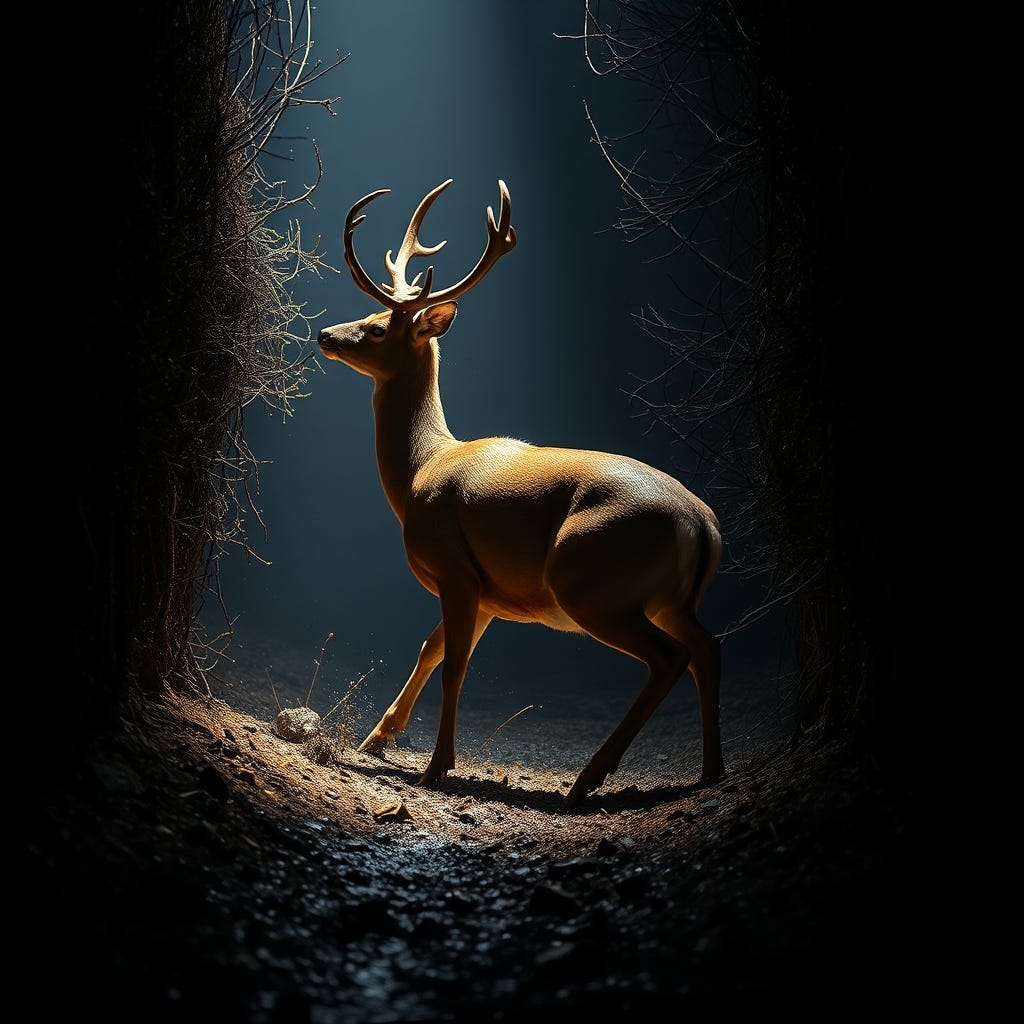
In a kinematic simulation, if a creature is blocked, it simply stops. In a physics simulation, if a creature is blocked, it reacts. Because the body has mass and momentum, an obstacle doesn’t just halt the path — it creates a collision response. A deer running into a dense thicket doesn’t freeze at the boundary. It stumbles. It pivots. It is deflected. The world acts back, and the body must answer.
The server said “Go North.” The world said “No.” The Body decided how to handle the “No.”
That handling — the stumble, the redirect, the physical reckoning with geometry the server never specified — is emergent. It is the creature expressing a response that arises entirely from the interaction between its dynamics and the shape of the world. In Mathematics, I showed that reconciliation is issued as intent — that the creature flies back to its consensus position under its own dynamics. In a force-based body, that reconciliation becomes a restoring force: a physical pull toward the authoritative position that reads, to the observer, not as a decision but as weight. The creature doesn’t change its mind; it is drawn. The distinction matters. Decisions belong to minds. Weight belongs to bodies. And it is the body we are building here.
The “No” is the most important part of the simulation. It is the resistance that makes the creature an other.
V. The Manifold of Resistance
If The Mathematics of Līlā was about the Vector Field of Desire, The Physics of Līlā is about the Manifold of Resistance.
The feeling of presence arises in the gap between the two. It is the tension between the creature’s will to move and the world’s refusal to let it move easily. It is the struggle to maintain the limit cycle against the entropy of the terrain.
In this architecture, we do not simulate life by mimicking its appearance. We simulate it by mimicking its constraints. We provide the creature with a mind that wants, a body that weighs, and a world that resists.
The non-verbal other is not a puppet. It is a dynamical system trying to solve a problem. And when we watch it struggle, when we see it stumble and recover, when we see it navigate the mud with a heavy, determined gait — we are not looking at a script. We are looking at a thing that is, for a brief moment, trying.
This is part of an ongoing project līlā, building a distributed ecosystem simulation.
This is fascinating and I can’t wait to see it come together